REVIEW · SPAIN PALACE TOURS
Madrid: El Escorial & Valley of the Fallen Fast Track Entry
El Escorial is the star of this outing: a vast royal monastery where Spanish kings were buried, rulers lived, art was collected, and Philip II built a monument to faith and empire. I like that the tour pairs it with the Valley of the Fallen, a very different and more difficult site tied to Spain’s Civil War and dictatorship. I also like the easy bus ride from central Madrid, with mountain views along the way.
The main drawback is the pace. The full visit lasts about five and a half hours, but only 75 minutes are set aside for El Escorial and 45 minutes for the Valley of the Fallen. Strict timing and uneven English delivery can make the experience feel rushed, especially if you want photographs or a quiet moment inside the basilica.
Key points to know before booking
- Two major monuments in one half-day: Visit the royal monastery at El Escorial, then continue to the Valley of the Fallen.
- A remarkable royal burial place: The Pantheon contains the tombs of almost all Spanish kings since Emperor Charles V.
- The cross is enormous: The Valley of the Fallen’s Christian cross rises about 150 meters above the site.
- The bus saves planning time: Transport from Calle de Ferraz takes you directly to both places and back to Madrid.
- The tour runs on a tight clock: Bathroom breaks and meeting times matter, and free time is limited.
- The second stop needs context: The Valley of the Fallen is visually powerful but politically and historically controversial.
Why this half-day trip matters
Madrid has plenty to fill a city break, but these two sites show a side of Spain you cannot get from the Prado or the Royal Palace. El Escorial explains how monarchy, Catholic faith, art, and imperial power were joined together. The Valley of the Fallen confronts you with the memory of civil conflict and dictatorship.
The contrast is useful. El Escorial is ordered, formal, and tied to the Spanish crown. The Valley of the Fallen is stark, monumental, and marked by painful political memory. Seeing both in one day gives you a clearer sense of how Spain has used architecture to express power.
The tour costs $68 per person. That is fair if you value direct transportation, admission, and a guide who can explain the rooms and monuments as you go. A do-it-yourself visit might give you more time at each site, but you would need to arrange transport between Madrid, San Lorenzo de El Escorial, and the Valley of Cuelgamuros. For many visitors, the convenience makes the price reasonable.
Still, this is not a slow sightseeing day. You are buying access and structure, not hours of free wandering.
Other palaces people book in Spain:
- Seville: Royal Alcázar Entry Ticket
★ 4.6 · 28,378 reviews - Granada: Alhambra & Nasrid Palaces Tour with Tickets
★ 4.7 · 19,801 reviews - Granada: Alhambra and Nasrid Palaces Entry Ticket
★ 4.6 · 15,130 reviews
Leaving Madrid from Calle de Ferraz
The meeting point is the Tours & Tickets Office at Calle de Ferraz, 3, near Ventura Rodríguez Metro station on Line 3, also called the Yellow Line. Go inside the office to show your GetYourGuide voucher. Do not simply wait on the pavement and assume the bus will find you.
The departure process deserves care. The bus can leave promptly, even if you are only a few minutes late. A late arrival once caused several people to miss the departure, and catching up at El Escorial made the start of the day more stressful. I would arrive early, allow extra time for the metro or taxi, and keep the office and tour details handy.
The ride to El Escorial takes about one hour. You pass through the Sierra de Madrid, and the changing views are one of the quieter pleasures of the trip. This is not a sightseeing bus with stops along the way, but the route gives you a sense of how quickly Madrid gives way to open country and mountain scenery.
The return ride takes about 50 minutes. With the two visits and the bus journeys, the total duration is listed as 330 minutes, or five and a half hours.
El Escorial: Philip II’s royal machine
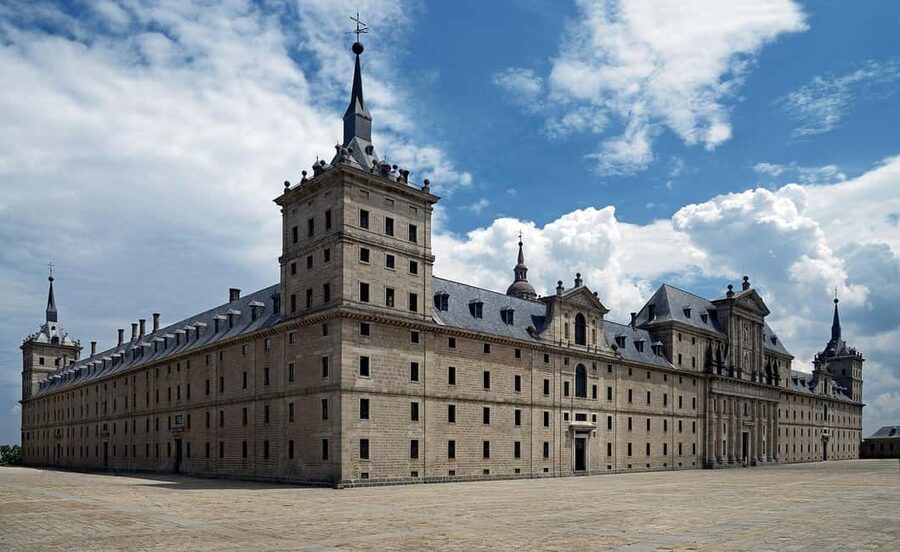
The Royal Monastery of El Escorial is much more than a monastery. Philip II commissioned it as a royal residence, monastery, basilica, library, art collection, and burial place. The result is a grand complex that feels deliberately serious rather than playful or decorative.
The guided visit lasts about 75 minutes. That is enough to cover the main highlights, but not enough to inspect every corner. You will want to stay close to the guide and listen through the supplied radioguide system. In a large complex, the audio equipment helps you follow the explanation without crowding around the guide.
The Basilica is one of the essential stops. Its scale and formal design show the close link between the Spanish monarchy and Catholicism. The building was meant to project authority, devotion, and control. You are not simply looking at an old church. You are seeing how a king shaped an entire institution around his political and religious vision.
The Pantheon of Kings is another major reason to come. Almost all Spanish kings since Emperor Charles V are buried here, making it one of the clearest places to trace the country’s royal dynasties. The tombs turn a long list of monarchs into something physical and immediate.
The Royal Library adds another side to the complex. It reflects the importance of learning and collected knowledge to the monarchy. The palace rooms show how the royal family used the building as a residence, while the art and architecture reveal the wealth behind the Spanish Empire.
I would not expect a relaxed stroll. Several outings have felt compressed, leaving little time to stop for photographs or admire the building from outside. The schedule also does not provide much time to walk around the exterior and take in the full scale of the facade. If you love architecture and want to study details, a separate visit to El Escorial would suit you better.
A short break before the second monument
After El Escorial, you get a little free time for coffee before the bus continues to the Valley of Cuelgamuros. Treat this as a quick pause, not a full meal stop. Lunch is not included, and the schedule is too tight for a leisurely restaurant visit.
Plan your food and water carefully. One account describes a no-eating and no-drinking rule on the bus, and another found five and a half hours without a snack or drink difficult. Rules can depend on the outing, but you should not count on eating during the rides. Have something before departure and use the bathroom when the guide provides the chance.
The guide may also ask everyone to use the bathroom before entering El Escorial because later opportunities can be limited. That advice is practical, even if the timing feels abrupt. Stay aware of where the group is going after any stop.
Same city, a very different set of state rooms:
- Madrid: Royal Palace Fast-Access Admission Ticket
★ 4.6 · 13,856 reviews - Seville: Alcázar, Cathedral & Giralda Skip-the-Line Tour
★ 4.8 · 11,525 reviews - Seville: Cathedral, Giralda & Alcazar Entry With Guided Tour
★ 4.6 · 8,560 reviews - Madrid: Royal Palace Expert Guided Tour with Skip-the-Line
★ 4.7 · 8,407 reviews
The Valley of the Fallen and its 150-meter cross
The second visit takes you to the Valley of the Fallen, now also known as the Valley of Cuelgamuros. The site is set in a protected natural area with striking mountain scenery. Its setting is part of the experience: the immense monument appears against open country rather than a city street.
The cross is the first detail that catches your eye. At about 150 meters high, it is described as the tallest Christian cross in the world. Its scale is difficult to take in from close up. The monument was designed to dominate the valley, and it does so with a force that is both impressive and unsettling.
The basilica is carved into the rock. Inside, the atmosphere changes from open mountain air to a heavy, enclosed interior. The stone and monumental scale create a dramatic setting, and the guide explains the site’s place in Spain’s twentieth-century history.
You should come ready for a serious visit. The Valley of the Fallen is controversial because of its links to the Spanish Civil War and the dictatorship that followed. It is not just a religious monument or an engineering feat. It is also part of a continuing conversation about memory, political power, and how a country presents a painful past.
The guided visit lasts about 45 minutes. That gives you the basic story and the main interior sights, but it may feel brief if you want time to reflect, photograph the setting, or examine the architecture closely. The site can be especially striking in poor weather. Snow, mist, or gray skies can make the stonework and mountain setting feel austere, though weather can also make the visit less comfortable.
Photography rules are strict. Flash photography is not allowed, and the guide may give firm instructions about where you can stand. Follow those directions, especially inside the basilica.
The guide and language question
The tour is offered in English and Spanish, with a live guide and radioguide service. In the best case, the guide gives clear explanations in both languages and keeps the group moving through the large sites.
The quality of the bilingual delivery matters a great deal here. One outing included an English-speaking participant who felt that most of the commentary was in Spanish. If you book specifically for English, confirm the language arrangement at the start and ask politely when you need clarification.
The group may also include people with different needs and expectations. Some want a fast overview, while others want time for photos, prayer, or quiet reflection. The guide has to keep everyone together, but the schedule leaves little room for personal requests.
If you hope to light a candle, speak with a priest, or have a rosary blessed, ask exactly how much time is available and where you should meet the group afterward. Do not assume the guide will wait once the formal visit ends. El Escorial is large, and it is easy to lose the group if you stop without clear instructions.
What the timing means in practice
The schedule is efficient but firm:
- About one hour by bus from Madrid to El Escorial
- About 75 minutes for the guided monastery visit
- A short coffee break
- About 45 minutes at the Valley of the Fallen
- About 50 minutes back to Calle de Ferraz
That leaves little spare time. You will get a useful introduction to both monuments, but you will not have the freedom to linger. Keep the radioguide close, remain alert at crossings and entrances, and move when the guide moves.
The pace may be hard for anyone who prefers frequent stops or needs extra time to walk. Comfortable shoes and comfortable clothing are specifically advised. No accessibility details are provided, so ask the operator before booking if you have mobility concerns or need a slower pace.
The strongest reasons to go
I would choose this outing for three main reasons. First, El Escorial is one of the best places near Madrid to understand Spain’s monarchy and royal burial traditions in one setting. The Pantheon, Basilica, library, palace rooms, and art collection make the visit far more substantial than a quick look at an old monastery.
Second, the combination is unusual. Many day trips focus on one historic town or palace. Here, you see royal Spain and twentieth-century political memory on the same route. The difference between the two sites gives the day its purpose.
Third, the bus removes much of the transport work. You can leave central Madrid, see two important monuments, and return before the day is over. For a first visit to Madrid, that is a useful way to reach places that are not in the center.
The reasons to think twice
I would hesitate if your main goal is photography, independent exploration, or a relaxed pace. The guided time is short, and the group may move quickly from room to room. The exterior of El Escorial deserves more time than the schedule allows, and the Valley of the Fallen can leave you wanting a longer pause.
I would also think twice if you need a dependable, evenly split English and Spanish explanation. The tour is advertised in both languages, but the balance can vary by guide and group. The listed rating of 4 from 16 evaluations suggests a generally worthwhile experience with some important complaints about pace, communication, and organization.
The strict departure policy is another concern. Arrive early at Calle de Ferraz, 3. A taxi delay or a few minutes spent paying can be enough to leave you behind.
Who will get the most from this tour
This is a good match for you if you want:
- A structured introduction to two major sites outside Madrid
- Royal history, religious architecture, and Spanish dynasties
- A guide to explain the Pantheon and the Valley of the Fallen
- Comfortable coach transport rather than several separate connections
- A half-day outing that returns to Madrid
You may prefer another arrangement if you want a full day at El Escorial, more time for personal prayer, detailed architectural study, or a slower visit with plenty of photographs.
Free cancellation up to 24 hours before departure and the reserve-now, pay-later option make planning less risky. Those terms help if your Madrid schedule is still changing, but they do not solve the tour’s main issue: the limited time at each site.
Should you book it?
Book this tour if you value convenience, context, and variety more than free time. At $68, transport, two guided visits, and a bilingual guide make it a sensible way to see El Escorial and the Valley of the Fallen in one morning or afternoon.
Skip it if you are easily frustrated by strict schedules or uneven language delivery. In that case, visit El Escorial independently and give it the time it deserves. If you do book, arrive early, wear comfortable shoes, use every bathroom stop, bring food for before or after the bus rides, and keep your expectations focused on a well-organized overview rather than an unhurried exploration.
FAQ
Where does the tour begin?
It begins at the Tours & Tickets Office at Calle de Ferraz, 3, in Madrid. The nearest Metro station is Ventura Rodríguez on Line 3, also called the Yellow Line.
How long does the entire experience last?
The listed duration is 330 minutes, or about five and a half hours. This includes the bus rides, guided visits, and the short break between the two sites.
How long is the bus ride to El Escorial?
The coach journey from Madrid to El Escorial takes about one hour. The return ride from the second site to Calle de Ferraz takes about 50 minutes.
What languages are available?
The live tour guide speaks English and Spanish. A radioguide service is also provided so you can listen to the guide during the visits.
What can I see at El Escorial?
The guided visit includes the Basilica, the Pantheon with the tombs of almost all Spanish kings since Emperor Charles V, the Royal Library, and the royal palace quarters.
What is the Valley of the Fallen?
The Valley of the Fallen is a monumental complex in the Valley of Cuelgamuros. It includes a basilica carved into rock and a Christian cross that rises about 150 meters.
Is lunch included?
No. Lunch is not included. The schedule provides only a short opportunity to have coffee before continuing to the Valley of the Fallen.
Can I cancel the booking?
You can cancel up to 24 hours in advance for a full refund. The reserve-now, pay-later option lets you hold a place without paying immediately.
Just added around Spain
- Private guided tour of the Alcazar de los Reyes Cristianos★ 5.0 · 6 reviews
- Mosque-Cathedral, Alcazar & Synagogue with Skip the Line Tickets★ 5.0 · 46 reviews
- Private official tour guide for visit to Alhambra in Granada from Cordoba Hotel★ 4.0 · 5 reviews
- Visita guiada a la Mezquita Catedral y el Alcázar de los Reyes Cristianos★ 4.0 · 4 reviews
- Mosque, Alcazar and Juderia Ticket Included Skip the Line★ 5.0 · 3 reviews
- Guided Tour of Monumental Cordoba: Jewish Quarter, Alcazar and Mosque★ 4.5 · 99 reviews
- Mosque, Alcazar of the Christian Monarchs and Juderia★ 3.5 · 3 reviews
- Guided tour of the Alcazar de los Reyes Cristianos in Spanish★ 5.0 · 36 reviews
Spain Palace Tours, compared.

Alcázar, Cathedral & Giralda Skip-the-Line Tour
Read our review →
Cathedral, Giralda & Alcazar Entry With Guided Tour
Read our review →
Royal Palace Expert Guided Tour with Skip-the-Line
Read our review →