
REVIEW · COPENHAGEN PALACE TOURS
Copenhagen: Amalienborg Palace Museum Entry Ticket
Amalienborg Museum puts you inside the private world of Denmark’s royal family, not just in front of another grand palace facade. You walk through rooms left much as their occupants used them, including Christian X’s dark study, Queen Louise’s salon, and a dining room set for royal life. I especially like the personal scale of the museum and the way ordinary belongings give the monarchy a human face. I also like the well-planned route, which makes this an easy visit for families and first-time palace explorers.
The main caution is value. At $19 per person, the museum is not huge, and many people spend only 45 minutes to an hour inside. You are paying for carefully preserved rooms and a concentrated history lesson, not a full-day palace complex with gardens and many wings. A separate guided tour is not included.
Key points at a glance
- Royal rooms from 150 years: See spaces used by Christian X, Queen Alexandrine, and Queen Louise.
- The Gala Hall: Look up at an 8-meter ceiling, gilded decoration, and work by Nicolai Abildgaard and Bertel Thorvaldsen.
- Fabergé jewelry: View Russian pieces from 1860 to 1917, including a coronation brooch made for Tsar Nicholas II.
- Family-friendly presentation: Children’s audio material is available in the museum sections, making the visit easier for younger readers.
- Simple city-center stop: The museum is about a 15-minute walk from central Copenhagen, according to the supplied visitor information.
- Important entry detail: Exchange and scan your online ticket downstairs at the cashier before going upstairs.
Amalienborg Museum is about people, not only palaces
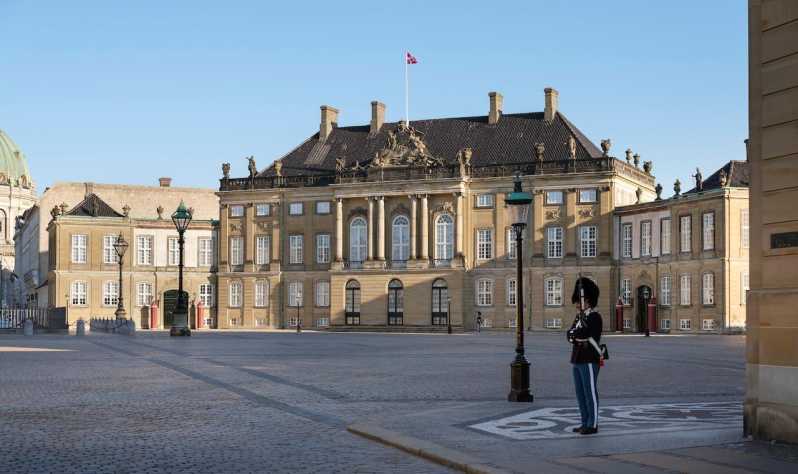
Amalienborg is one of Denmark’s main royal residences, but the museum occupies only one of the four buildings around the square. You enter Christian VIII’s Palace, where the museum presents the monarchy across roughly the last 150 years.
That distinction matters. You are not touring every part of Amalienborg, and you are not entering rooms currently used by the royal family. Instead, you see historic apartments and ceremonial spaces preserved as they looked during the lives of earlier royal occupants.
I find this approach more interesting than a palace tour made up only of grand halls. A study with heavy furniture, a dining room arranged for family life, and framed photographs can tell you how a person lived. The objects also place the Danish monarchy in a wider European setting, where marriages, family ties, and political connections stretched across borders.
The route is organized to give you both sides of royal life. Some rooms are formal and impressive. Others are private and slightly old-fashioned. Together, they show how the monarchy moved between public duty and domestic routine.
More palace museums and galleries in Copenhagen:
- Vienna: Skip-the-Line Sisi Museum, Hofburg and Gardens Tour
★ 4.8 · 5,918 reviews - Venice’s Best: Basilica, Doge’s Palace, Gondola & History Gallery
★ 4.5 · 2,478 reviews - Vienna: Hofburg and Empress Sisi Museum Guided Tour
★ 4.7 · 1,460 reviews
Entering Amalienborg Square from Frederiksgade
The museum entrance is in the first building on your left when you enter Amalienborg Square from Frederiksgade and the Marble Church. This is a useful detail because the four matching buildings can make the complex confusing at first.
Your online ticket is not the final step at the door. Before going upstairs, you need to go downstairs to the cashier, where staff scan or exchange the QR code for the museum ticket. Give yourself a few extra minutes for this process.
Arriving more than 20 minutes late means the ticket is no longer valid, so do not treat the booking time casually. The ticket itself is valid for one day, but the stated activity information asks you to check availability for the starting times offered when you book.
Large bags, backpacks, large purses, luggage, food, and drinks are not allowed inside. Baby strollers are also listed as prohibited, so plan accordingly. Assistance dogs are allowed, but other pets are not.
Christian X’s study and the feel of royal work

One of the most revealing rooms is Christian X’s study. It has been preserved as if the king had just left, with dark walls and heavy furniture typical of a gentleman’s study around 1900.
The room also reflects his background as an officer. That detail helps you read the furniture and decoration as part of a personality, rather than as a random period display. The study feels practical and serious, a useful contrast to the grander rooms elsewhere in the museum.
You can spend a few minutes looking at the layout and then ask yourself what the room says about its owner. The museum works best when you do this. It does not require you to know every royal date in advance. The objects and interiors provide clues, while the written material supplies the historical frame.
If you have a child with you, the museum’s audio material can help keep the visit moving. A seven-year-old is specifically noted as enjoying the child-focused audio content available in each section. That makes the study and other quieter rooms easier to handle as a family stop.
Christian X and Queen Alexandrine’s dining room
The dining room of Christian X and Queen Alexandrine appears much as it did during their time at Amalienborg. They lived in the palace from 1899 until Christian X died in 1947 and Alexandrine died in 1952.
A dining room may sound less dramatic than a throne room, but it gives you a clear sense of royal domestic life. The setting connects the names and dates to a couple who ate, entertained, and spent family time in this space over many decades.
I would not rush through this room. Look for the arrangement of the furniture and the overall mood rather than expecting a large number of individual objects. The value is in seeing a complete interior held together as a lived-in setting.
This is also where the museum’s focus on family becomes clear. Amalienborg is not presenting the Danish monarchy only as ceremony and state occasions. It shows a household, with all the visual clues that come from rooms kept in place.
More palace entry tickets in Copenhagen:
- Copenhagen: Christiansborg Palace Entry Ticket
★ 4.6 · 717 reviews - Copenhagen: Rosenborg Castle Entry Ticket
★ 4.6 · 381 reviews - Rosenborg Castle Entry Ticket in Copenhagen
★ 3.5 · 22 reviews - Copenhagen: Rosenborg Castle Tour with Skip-the-Line Ticket
★ 4.2 · 14 reviews
Queen Louise’s private salon and a European family network
Queen Louise’s private salon dates from around 1895 and reflects the more modern interior decoration of that period. Paintings and framed photographs on the tables point to her extensive family life and close connections across Europe.
The salon is a good stop for understanding how a royal interior could function as a social and family record. The photographs are not just decoration. They show the relationships that linked the Danish royal household with other European courts.
You will likely find this room more intimate than the Gala Hall. Its importance comes from the combination of personal items, family images, and period design. I like that the museum lets you move from a king’s workroom to a queen’s private social setting without turning either room into a theatrical reconstruction.
For visitors who prefer people and stories to architectural detail, Queen Louise’s salon may be one of the strongest parts of the route. For those mainly interested in grand architecture, it will feel quieter and less spectacular.
The Fabergé Chamber and royal connections with Russia
The Fabergé Chamber displays hand-crafted Russian jewelry made between 1860 and 1917. The collection has a particular focus on the close ties between the Danish and Russian monarchies.
The most pointed object is the Fabergé coronation brooch, created for the coronation of Tsar Nicholas II. That single piece gives the room a useful historical anchor. You are not simply looking at attractive jewelry. You are seeing how royal families expressed status, ceremony, and political relationships through objects made for special occasions.
The chamber also adds variety to the visit. After several furnished rooms, the jewelry brings you closer to small, finely made objects that reward careful looking. If you are interested in decorative arts, this may be the museum’s strongest section.
Do not expect a large jewelry museum. The chamber is part of the wider palace route, not a separate collection requiring hours. Its value comes from the quality of the objects and the story behind the Danish and Russian connection.
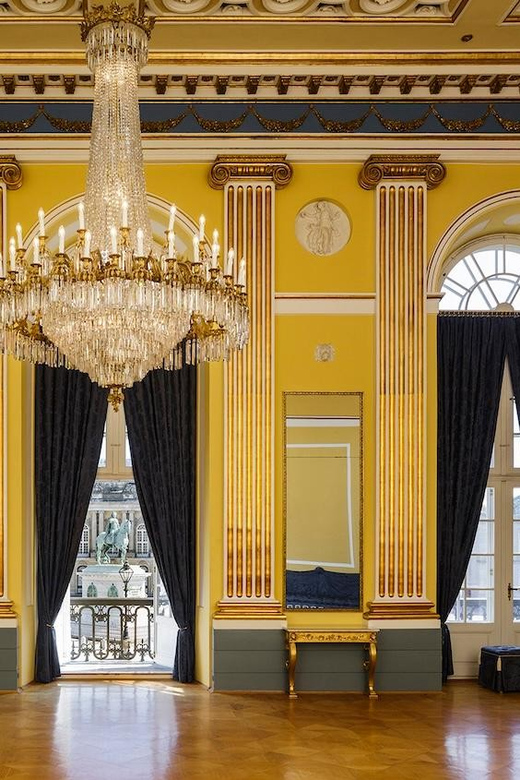
The Gala Hall, with an 8-meter ceiling
The Gala Hall provides the grandest architectural moment in the museum. Its ceiling rises 8 meters above a lavishly gilded interior, and the room looks out toward the palace square.
In 1794, the royal family commissioned Nicolai Abildgaard to design the interior. Sculptor Bertel Thorvaldsen created the sculptures. Knowing those names gives the room more weight, but you do not need an art-history background to appreciate its scale.
After the smaller private rooms, the Gala Hall opens the experience up. It is the place to pause, look upward, and take in the relationship between the decoration and the space itself. The contrast with Christian X’s study is one of the route’s strengths.
This is also the room most likely to satisfy visitors who expect a palace visit to include something grand. Still, it is only one major ceremonial space, so adjust your expectations. Amalienborg Museum offers a compact royal interior experience rather than an enormous sequence of state apartments.
What the historical route teaches you
The museum covers about 150 years of Danish royal history through rooms, objects, photographs, paintings, and personal belongings. That span gives you a basic sense of changing tastes and changing royal roles.
The interiors also show that monarchy is not one fixed style. Christian X’s study is dark and formal. Queen Louise’s salon feels more social and personal. The Gala Hall is ceremonial and theatrical. The Fabergé jewelry connects the Danish court to Russia and to wider European royal networks.
That variety is why I would choose this museum over a simple exterior visit if you want context. Amalienborg Square can show you the setting, but the museum explains the people who occupied it.
You will not get a long lecture from a guide because no guided tour is included. Instead, you move at your own pace through the displays. That works well if you want to stop for photographs, read selected panels, or keep children moving. It is less suitable if you want a specialist to explain every royal connection in detail.
The Frederik X exhibition and its date
The special exhibition Frederik X: King of Tomorrow was scheduled from March 22 through September 8, 2024. It marked the succession of the Danish throne on January 14 and used photographs, objects, video clips, paintings, and sound to present a portrait of the new king.
Because those dates have passed, you should not assume this exhibition is still available. The museum ticket includes all exhibitions operating during your visit, but the current special display can change.
The exhibition is useful context for anyone interested in the modern monarchy because it connects the historic rooms with a recent change in the Danish royal line. It also gives the museum a contemporary layer, rather than leaving you with only earlier generations.
If you are booking after September 8, 2024, check the current exhibition information before paying. The permanent museum remains the main reason to visit, but a temporary display can affect how much value you get from the $19 ticket.
How long to allow and who will enjoy it
Most people should allow about 45 minutes to an hour inside. One hour is enough to follow the route without rushing, read the main information, and spend time in the Gala Hall and the more personal rooms.
You can pair the museum with time outside in Amalienborg Square, which takes longer than the indoor visit for some people. The museum is also about a 15-minute walk from central Copenhagen, making it easy to add to a day of sightseeing without planning a separate transport outing.
I would recommend it most strongly to:
- Families wanting a manageable indoor history stop.
- First-time visitors curious about the Danish monarchy.
- People who enjoy preserved interiors and personal objects.
- Anyone already visiting the Marble Church or Amalienborg Square.
- Visitors interested in European royal connections and decorative arts.
I would be more cautious if you expect a large palace with many rooms, extensive gardens, or a guided presentation. The visit is compact, and the price can feel high if you judge it only by the number of rooms.
Is the $19 ticket good value?
At $19 per person, the ticket is fair if you care about royal interiors, family history, or the chance to see rooms preserved in place. The Gala Hall, Fabergé Chamber, royal study, dining room, and private salon offer enough variety to make the visit feel complete, even though it is not long.
The value is weaker for anyone looking only for a quick look at a grand building. You can see the palace exterior and square without buying this ticket, while the indoor museum asks you to pay for the historical detail and preserved rooms.
I also like the flexible cancellation terms: you can cancel up to 24 hours in advance for a full refund, and the reserve-now, pay-later option lets you keep plans open. These terms are practical when you are arranging several Copenhagen visits, but they do not change the basic question of whether the museum’s subject interests you.
The ticket includes entry and access to all exhibitions running during your visit. It does not include a guided tour, so budget and plan separately if you want expert commentary.
Access and practical planning
The museum is wheelchair accessible. That makes it a practical choice for visitors who need an accessible indoor attraction, though the supplied information does not give further details about lifts, seating, or restroom facilities.
Plan to arrive on time, especially since a delay of more than 20 minutes can cancel the validity of your ticket. Keep your belongings small, and do not arrive carrying food, drinks, luggage, large bags, or a stroller.
The downstairs ticket scan is the detail most likely to catch you off guard. Have the online QR code ready, but expect to present it at the cashier before going upstairs. Once inside, the route is straightforward and should not require a guide to understand.
Should you book Amalienborg Museum?
Book it if you want the human side of the Danish monarchy: a king’s study, a queen’s private salon, a family dining room, Russian jewelry, and one imposing ceremonial hall. The route is easy to manage, family-friendly, wheelchair accessible, and close enough to central Copenhagen to fit neatly into a walking day.
Skip it if you want a huge palace complex or a full guided tour. At $19, the museum earns its price through preserved interiors and personal detail rather than sheer size.
For most first-time Copenhagen visitors with an interest in royal history, I would make room for it, especially alongside the Marble Church and Amalienborg Square. Allow an hour, arrive early enough to handle the downstairs ticket exchange, and judge the visit as a focused museum stop, not an all-day palace adventure.
FAQ
Where is the Amalienborg Museum entrance?
The entrance is in the first building on your left when you enter Amalienborg Square from Frederiksgade or the Marble Church.
What does the ticket include?
The ticket includes entry to Amalienborg Palace Museum and access to all exhibitions available during your visit.
Is a guided tour included?
No. The ticket provides museum entry, but a guided tour is not included.
How long is the ticket valid?
The ticket is valid for one day. You should check the available starting times when booking.
How long does the museum visit take?
The visit generally takes about 45 minutes to an hour, based on the supplied activity information.
Can I bring a large bag or stroller?
No. Large bags, backpacks, large purses, luggage, food, drinks, and baby strollers are not allowed inside. Assistance dogs are allowed, but other pets are not.
What happens if I arrive late?
You need to present and scan your online ticket downstairs at the cashier before going upstairs. If you arrive more than 20 minutes late, the ticket is no longer valid.
Just added around Copenhagen
- Round Tower, Rosenborg Castle and Old Town Copenhagen Tour★ 4.5 · 4 reviews
- Private Copenhagen City Tour with Rosenborg Castle★ 5.0 · 14 reviews
- walking tour – Copenhagen and Christiansborg 3 hours★ 4.0 · 7 reviews
- Full-Day Tour; Castle, Palace & Cathedral, Winter(JAN-MAR)★ 5.0 · 11 reviews
- Private Tour to Frederiksborg Castle★ 5.0 · 11 reviews
- 4-Hour Private Half-Day Frederiksborg Castle Tour★ 5.0 · 9 reviews
- Rosenborg Castle Entry Ticket in Copenhagen★ 3.5 · 22 reviews
- Copenhagen & Christiansborg Palace Private Walking Tour★ 5.0 · 3 reviews
Copenhagen Palace Tours, compared.

Kronborg, Frederiksborg Castle and Roskilde Tour
Read our review →


Full-Day; Castle, Palace, Cathedral & Viking ships Tour
Read our review →
Kronborg (Hamlet Castle) & Frederiksborg Castles: PRIVATE TOUR
Read our review →
Copenhagen City & Christiansborg Palace Private Walking Tour
Read our review →
Rosenborg Castle Tour with Skip-the-Line Ticket
Read our review →Browse the lists this tour appears in