
REVIEW · SPLIT PALACE TOURS
Walking Tour of Split and Diocletian’s Palace
Diocletian’s Palace is not a single old building waiting behind a ticket gate. It is the living center of Split, with homes, shops, cafés, lanes, and ancient walls woven together. This tour gives you a useful map of that maze, from the Peristyle and Vestibule to the Golden Gate and Riva Harbor.
I like the compact 90-minute route and the way it mixes Roman remains with later Venetian and Croatian history. I also like that guides such as Antonella, Anton, Marino, and Mario bring personal energy, humor, and clear local pride to the walk. The main drawback is sound: with several tours in the palace at once and no headsets, a soft-spoken guide can be hard to follow.
Key points to know before you book
- A smart first look at Split: The route connects Diocletian’s Palace with the Riva, Fruit’s Square, the Golden Gate, and the old town.
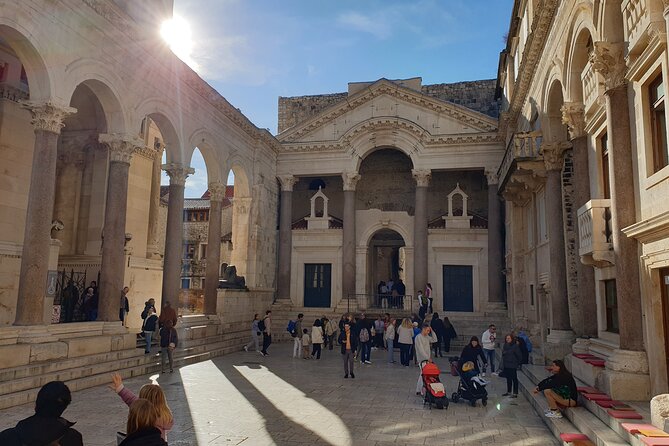
- The Peristyle is the heart of the walk: This central square helps you understand how the palace is laid out.
- The tour stays outside paid museum areas: Entry to the substructure museum and other admission sites is not included.
- Guide quality matters: Antonella, Anton, Mario, and Marino receive especially warm praise for humor, clarity, and enthusiasm.
- Expect uneven footing: High steps and irregular stone surfaces make sturdy shoes a sensible choice.
- Sound can be an issue: The maximum group size is 20, but no audio headsets are supplied.
Why this 90-minute walk works well in Split

Split can be confusing at first because Diocletian’s Palace is not sealed off from modern life. The palace walls form much of the old center, but the interior is a web of narrow passages and open courtyards. A guide helps you understand what you are looking at instead of treating every stone as just another old wall.
The route also gives you a useful sense of scale. You begin at the Peristyle, the palace’s central square, then move through the Vestibule and substructures before heading out through the Golden Gate. From there, the walk opens toward the waterfront, Fruit’s Square, and the old Jewish quarter.
At $48.37 per person, this is not the cheapest way to see Split. Still, the price can make sense if you want a structured introduction, clear historical context, and a chance to ask questions. It is less compelling if you only want to wander freely or plan to visit the paid palace areas on your own.
The tour is offered in English, takes about an hour and a half, and begins and ends at Peristil ulica. Several start times are available, which helps if you are fitting Split into a busy day. The advertised maximum is 20 people, though the feel of the walk may change depending on the actual group and the number of other tours nearby.
More walking tours past the palaces in Split:
- Split: Old Town and Diocletian Palace Walking Tour
★ 4.9 · 4,727 reviews - Split & Diocletian’s Palace Walking Tour
★ 5.0 · 1,125 reviews - Split: Diocletian Palace & Old Town Guided Walking Tour
★ 4.7 · 882 reviews
Starting at the Peristyle, Split’s ancient crossroads
The Peristyle is the best possible starting point. This grand square sits at the center of Diocletian’s Palace and connects to many of the important spaces inside it. Your guide uses the square to explain the basic plan of the palace, giving you a frame for everything that follows.
The setting does much of the work. Roman columns, stone paving, and later buildings sit together in a compact space that still functions as part of the city. You are not looking at a remote ruin. People pass through, meet friends, and use the surrounding streets as part of everyday Split.
The stop lasts about 15 minutes and has no admission charge. That makes it a strong opening because you get immediate visual impact without needing to handle tickets first.
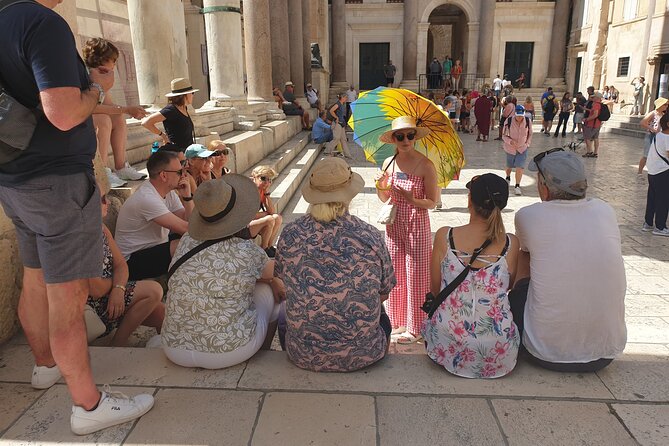
A practical warning: the Peristyle can be crowded, and several guides may be speaking at once. Stay close to your guide, especially if you are in a full group. The lack of headsets is the chief weakness of this experience, and it matters most in open spaces with competing voices.
The Vestibule and the sound of Dalmatian singing
The Vestibule was the ceremonial entrance to the emperor’s apartments. Its round form and stone construction give it a different feel from the open Peristyle, and your guide explains how it fitted into Diocletian’s palace.
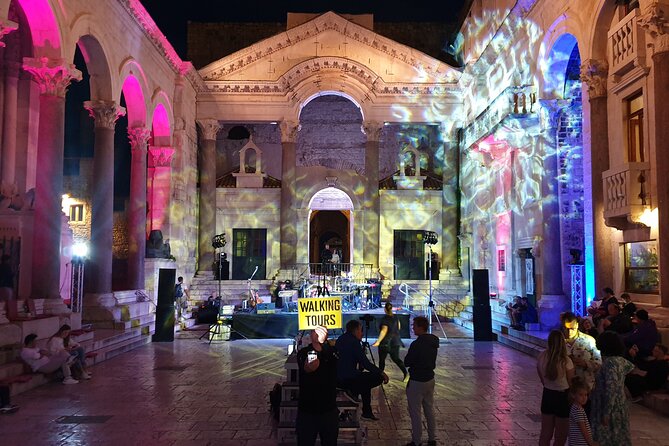
You may also hear traditional Dalmatian singing here. That possibility adds a welcome local touch, since the space has strong acoustics. It is a short stop, about five minutes, so do not expect a full concert or a long music presentation. Think of it as a brief connection between the architecture and the living culture of the region.
This is one place where a clear guide makes a big difference. The space is visually striking, but its purpose is not immediately obvious unless someone explains how people moved through the imperial complex.
The palace substructures and what they reveal
The substructures are among the most useful parts of the route because they show how the palace was built and how its spaces changed over time. Your guide discusses their construction and later functions, helping you understand that the palace was not frozen in its Roman form.
The tour does not include the museum section of the substructures. That is important when judging the price. You will get an introduction to the underground area, but you do not receive admission to every paid section.
I see this as both a limit and a practical advantage. The guided visit gives you a clear overview without turning the walk into a longer museum tour. If the underground architecture catches your interest, you can return afterward and visit the museum independently. If you want a detailed look at every excavated room, budget separately for admission.
The stop lasts about 10 minutes. Wear shoes with a firm sole, since the route includes uneven surfaces and high steps. The activity information specifically warns people with trouble managing high steps, and that warning is worth taking seriously.
A few more palace visits around Split worth a look
- Split Old Town and Diocletian’s Palace Tour
★ 4.8 · 716 reviews - Split: Game of Thrones Tour with Diocletian’s Palace Cellar
★ 4.8 · 545 reviews - Diocletian’s Palace and Old Town SMALL GROUP Walking Tour
★ 5.0 · 502 reviews - SPLIT-PRIVATE Walking Tour of Diocletian’s Palace & Old Town
★ 5.0 · 467 reviews
The Golden Gate and Gregory of Nin
The Golden Gate was the palace’s main entrance, and it gives the tour a clear transition from the imperial complex to the wider old town. Your guide explains the gate’s role and points out the statue of Gregory of Nin.
Gregory of Nin is important to Croatian history and language, and the statue is more than a decorative stop. The explanation connects Split’s Roman past with the later development of Croatian identity. That broader view is one of the tour’s strengths. You are not only hearing dates about an emperor. You are seeing how different periods overlap in the same city.
This stop takes about 10 minutes and is free to visit. It is also a good place to ask questions, since the subject moves beyond the basic palace story. Guides with a teaching background, including Marino and Antonella, seem especially well suited to this sort of explanation.
Riva Harbor and Split’s waterfront life
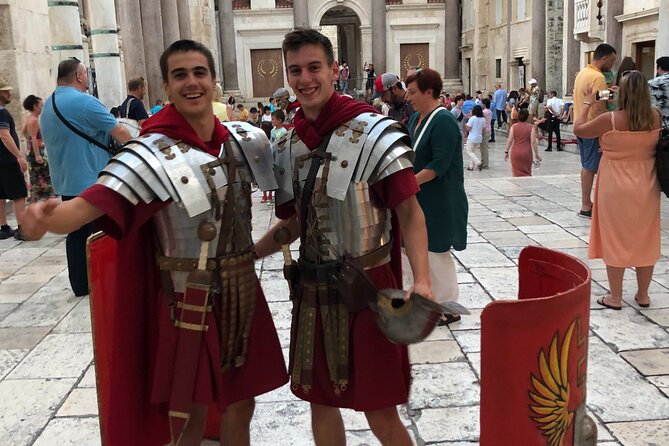
At Riva Harbor, you see a bronze model of Diocletian’s Palace and learn how the promenade developed. The waterfront gives you a chance to step back from tight lanes and look at Split as a whole.
The model is useful because the palace can be hard to picture from ground level. After walking through its gates, courtyards, and underground spaces, you can look at the miniature layout and connect the pieces.
The Riva also shows how strongly the old city remains tied to the sea. The stop lasts around 15 minutes, making it one of the longer pauses on the route. That extra time helps balance the indoor and enclosed sections of the palace.
This is a pleasant place to note where you might return later. The tour does not turn into a food or café walk, and it does not include free time for a waterfront meal. Still, the guide’s overview can help you decide how to spend the rest of your day.
Fruit’s Square and Split’s Venetian chapter
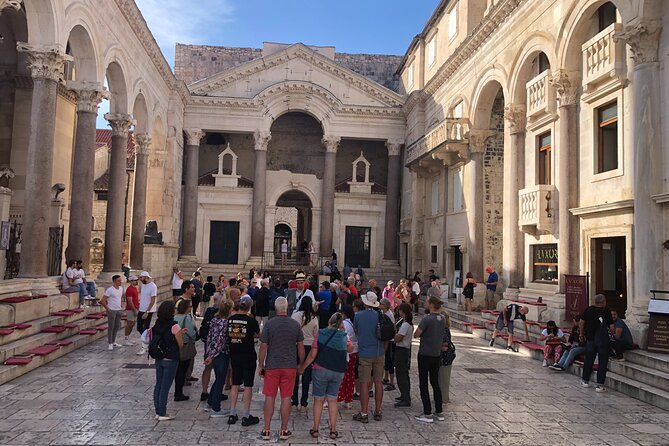
Fruit’s Square, also called Trg Brace Radic, adds a later period to the story. Here, your guide points out a 15th-century Venetian citadel and explains the importance of Marko Marulic, often described as the father of Croatian literature.
This stop is valuable because it keeps the experience from becoming only a Roman history lesson. Split’s identity was shaped over many centuries, and the Venetian influence is part of what you see in the old center.
The square is also a good example of how Split’s history is layered rather than neatly separated. A Roman palace, a medieval and Venetian town, and a modern Croatian city all occupy the same compact area. The guide’s job is to connect those layers without losing you in dates.
You spend about 10 minutes here. If your guide is a strong storyteller, this is likely to be one of the more memorable parts of the walk. Several highly praised guides are described as funny and effective at turning historical details into stories instead of a string of facts.
The Split Synagogue and the city’s Jewish story

The final listed stop is the 16th-century Split Synagogue. The group passes by while the guide explains the history of the Jewish community in Split.
The stop is brief, about 10 minutes, and admission is not included. The route does not promise a full interior visit, so set your expectations accordingly. Its value is the chance to hear about a part of the city’s past that can be easy to miss when attention stays fixed on Roman monuments.
Ending with this subject gives the walk a wider social frame. Split is more than palaces and emperors. Its old streets also carry the stories of communities, languages, and religious traditions that shaped the city.
The activity ends back at the meeting point, so you can continue exploring from the center without arranging a separate ride.
Guide style, group size, and hearing the commentary
The strongest part of this experience is likely to be the guide you receive. Antonella is repeatedly praised for being organized, funny, clear, and full of enthusiasm for Split. Anton and Anthony are described as energetic and engaging, while Mario is noted for answering questions beyond the planned subject. Marino is presented as a history teacher with strong passion for his city.
That range is useful to understand. This is not a recorded audio walk with a fixed script. Your experience depends on the guide’s voice, storytelling, English, and ability to manage the group.
The tour is capped at 20 people, which is more manageable than a large city tour. Yet even a group of 20 can spread out in narrow lanes or struggle to hear in a busy square. Several people found the commentary difficult when the guide spoke softly or when other groups were nearby.
I would stay near the guide and avoid drifting toward the back. If the operator later adds headsets, that would solve the main practical weakness. At present, you should not assume that an audio system is provided.
There have also been isolated organizational problems, including a delayed start after a booking issue and a reported cancellation with poor communication. Those incidents do not define the usual experience, but they are a reminder to check your confirmation and meeting details before setting out.
Who will get the most from this tour?
I would choose this tour if you have only a short time in Split, are visiting for one day, or want a historical framework before exploring alone. It is especially useful at the beginning of your stay because the route shows where the major areas fit together.
It suits adults, families with older children, and anyone who prefers context to aimless wandering. The activity is near public transportation, service animals are allowed, and most people can take part. The high steps and uneven ground are the main physical concerns.
You may want a different plan if you need full wheelchair access, dislike group walks, or want a detailed museum visit. The tour does not include admission tickets, and it does not promise entry to all paid parts of the palace.
Since several guides have a strong teaching and storytelling background, I would also recommend it to anyone who enjoys history presented through anecdotes and local perspective. The best guides appear to explain rather than simply recite.
Price, timing, and cancellation details
The cost is $48.37 per person. I consider that fair for a small-group introduction led by a live English-speaking guide, but only if you value explanation and orientation. The price is less attractive if you expect admission to the substructures museum or other paid palace areas, since no tickets are included.
Group discounts may be available, and the tour offers several start times. It is booked about 13 days ahead on average, so you do not need to plan a year in advance, but popular dates can still fill.
You can cancel for a full refund up to 24 hours before the local start time. Changes or cancellations within 24 hours are not refunded. The experience also requires a minimum number of participants, so if the operator cancels for that reason, you are offered another date or experience, or a full refund.
Should you book the Walking Tour of Split and Diocletian’s Palace?
I would book it as a first introduction to Split, especially for a one-day visit or a cruise stop. The route covers the city’s essential landmarks, and a good guide can make the palace feel like a connected place rather than a pile of impressive but unrelated stones.
The strongest reasons to book are the compact route, the mix of Roman, Venetian, Croatian, and Jewish history, and the chance to learn from guides such as Antonella, Anton, Mario, or Marino. The main reasons to hesitate are the price, the lack of included admissions, and the possibility that you will struggle to hear without headsets.
Book it early in your time in Split, stay close to the guide, wear shoes suited to uneven steps, and plan to return to the paid substructures museum if you want a fuller underground visit. With those expectations, this is a useful and engaging way to get your bearings in the old city.
FAQ
How long does the Walking Tour of Split and Diocletian’s Palace last?
The tour lasts approximately 1 hour and 30 minutes, though one review reported a shorter duration and another reported a much longer experience. Allow at least 90 minutes in your schedule.
Where does the tour begin and end?
The meeting point is on Peristil ulica, at Peristil in Split. The activity ends back at the meeting point.
Is admission to Diocletian’s Palace included?
No admission tickets are included. The tour visits and explains several areas, but entry to paid sections, including the museum part of the substructures, is not covered.
Is the tour offered in English?
Yes. The tour is offered in English and is led by a live guide.
How many people can join the tour?
The maximum group size is 20 people. The actual experience can still feel crowded in busy palace areas, particularly because headsets are not provided.
Is the tour suitable for people with limited mobility?
The tour is not recommended for people who have trouble with high steps. Uneven stone surfaces and stairs are part of the historic center route.
What is the cancellation policy?
You can cancel at least 24 hours before the local start time for a full refund. Cancellations or changes made less than 24 hours before the start are not refunded.
Just added around Split
- Split: Private Walking Tour and Diocletian’s Palace★ 5.0 · 3 reviews
- Split and Diocletian’s Palace walking tour with a local guid★ 4.9 · 36 reviews
- Split: Diocletian’s Palace Private walking tour★ 5.0 · 3 reviews
- Split: Jewish Heritage & Diocletian’s Palace Walking Tour★ 5.0 · 3 reviews
- Split: Private Walking Tour with Diocletian’s Palace★ 5.0 · 30 reviews
- Split: Old Town and Diocletian’s Palace Walking Tour★ 3.3 · 3 reviews
- Essential Diocletian’s Palace Tour for First-Time Visitors★ 4.9 · 79 reviews
- Split: Old Town & Diocletian’s Palace Earlybird Walking Tour★ 4.0 · 12 reviews
Split Palace Tours, compared.
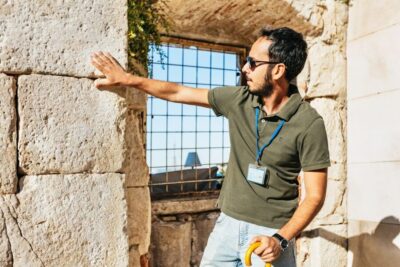


Diocletian Palace & Old Town Guided Walking Tour
Read our review →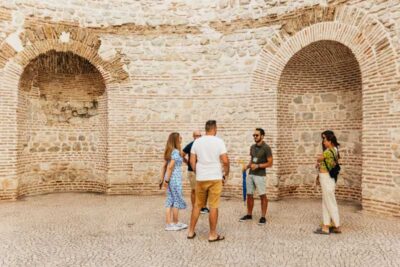

Game of Thrones Tour with Diocletian’s Palace Cellar
Read our review →
Diocletian’s Palace and Old Town SMALL GROUP Walking Tour
Read our review →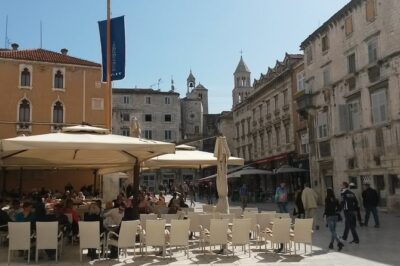
Split by Private Electric Rickshaw – Palace & Hidden Gems
Read our review →Browse the lists this tour appears in