
REVIEW · CROATIA PALACE TOURS
Dubrovnik Rector’s Palace Cultural History Museum Tour
Rector’s Palace is more than a pretty building on Dubrovnik’s main square. Inside, you’ll find the former working heart of the Republic of Ragusa, with ceremonial rooms, official portraits, old manuscripts, and the surprisingly memorable sedan chairs once used by Dubrovnik’s patricians. The palace is far larger and grander inside than its exterior suggests.
I like the private format, which gives your group room to ask questions and steer the conversation toward art, architecture, or political history. I also like the way the tour connects the palace with St. Blaise Church and the surrounding square, so you get more than a quick museum visit.
The main drawback is value. At $191.07 per person, this is a costly two-hour outing, particularly if you already have the Dubrovnik Pass, which includes admission to the palace. The price makes more sense for a small private group that wants a guide, not simply for someone seeking entry to the museum.
Key points at a glance
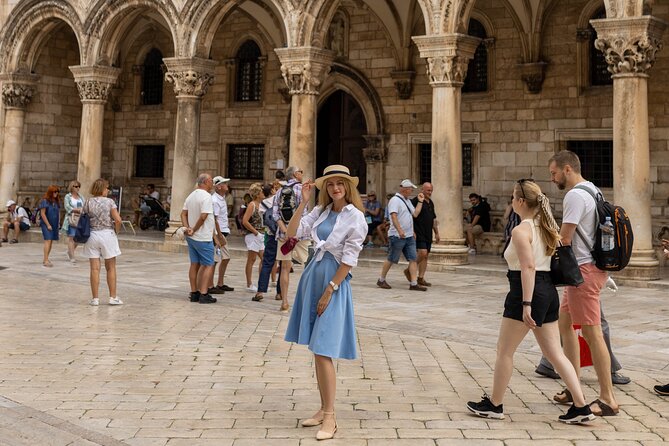
- The palace is much bigger inside than it looks from the square, with rooms shaped by Gothic, Renaissance, and Baroque design.
- The Cultural History Museum ticket is included, covering the permanent exhibition.
- A private English-language guide leads the visit, with a limit of 1 to 20 people per guide.
- Sedan chairs, ceremonial robes, portraits, and manuscripts bring Dubrovnik’s upper-class and political past into view.
- St. Blaise Church and its square add useful context about Dubrovnik’s religious life and city design.
- The meeting point is in front of NoneNina Bar, and you should not enter the bar because its staff are not involved with the tour.
Why Rector’s Palace matters in Dubrovnik
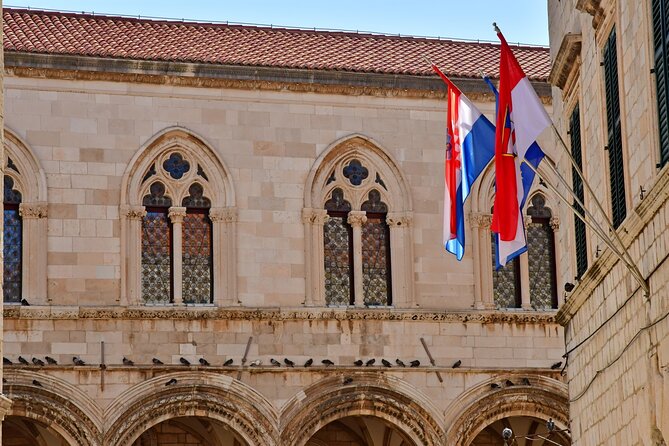
Dubrovnik’s old city can feel like a film set if you only admire its limestone streets and polished façades. Rector’s Palace helps explain how this small maritime republic actually worked.
The Republic of Ragusa was governed from here, and the palace served as the setting for leadership, diplomacy, official business, and ceremonies. Your guide uses the building to explain how Dubrovnik protected its independence and managed its relationships with other powers.
That political story gives the rooms more weight. A grand chamber is not merely an attractive interior. It was part of a system that controlled trade, received diplomats, recorded decisions, and presented Dubrovnik as a serious republic.
I find this setting especially useful early in a Dubrovnik visit. You begin to see the old city as a functioning society rather than a collection of beautiful streets. The palace gives you a framework for understanding the walls, churches, squares, and civic buildings you’ll encounter afterward.
More palace museums and galleries in Croatia:
- Vienna: Skip-the-Line Sisi Museum, Hofburg and Gardens Tour
★ 4.8 · 5,918 reviews - Venice’s Best: Basilica, Doge’s Palace, Gondola & History Gallery
★ 4.5 · 2,478 reviews - Vienna: Hofburg and Empress Sisi Museum Guided Tour
★ 4.7 · 1,460 reviews
Meeting your guide near the palace
The tour begins in front of NoneNina Bar at Ul. Pred Dvorom 4, close to Rector’s Palace. Treat the bar only as a landmark for finding your guide. Do not go inside to ask about the tour, since the staff are not informed about the activity.
The meeting arrangement is simple, but you should arrive with enough time to identify the exact spot. Dubrovnik’s Old Town streets are easy to walk but can be confusing at first, especially if you are arriving through a busy entrance or carrying luggage.
The tour lasts about two hours and ends back at the meeting point. It is a walking experience, so comfortable shoes matter. The route includes the palace and nearby outdoor areas, and the tour operates in sun or rain. Check the forecast and dress for the conditions rather than assuming the palace visit will keep you indoors the whole time.
You receive a mobile ticket, and confirmation is provided at booking. Check your email the day before for any important meeting instructions or updates.
Entering the grand halls of Rector’s Palace
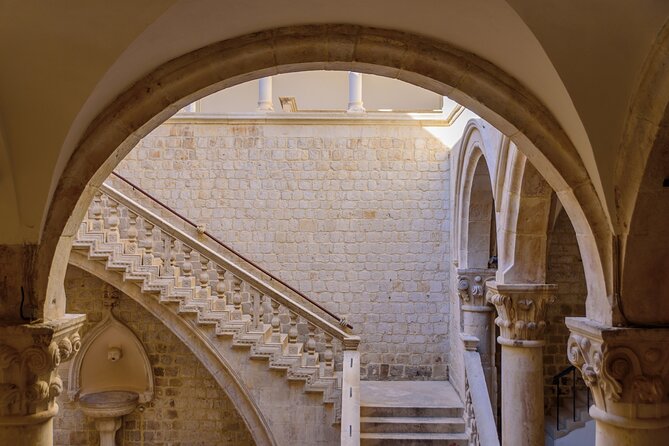
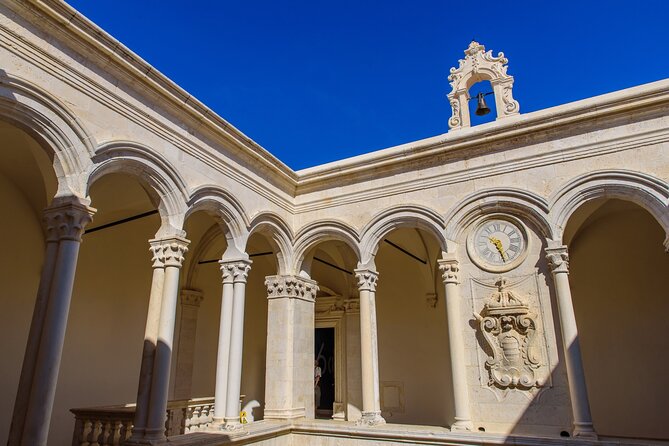
The palace itself is the strongest part of the experience. Its appearance reflects several building periods, with Gothic, Renaissance, and Baroque details sharing the same complex.
That mixture is not a flaw. It shows how Dubrovnik changed over time while maintaining the palace’s central role. You can expect the guide to point out how different architectural influences reflect the city’s long connections with nearby cultures and wider European politics.
The rooms help you read Dubrovnik’s social order. Ceremonial spaces suggest public authority, while more practical areas remind you that this was once a working seat of government. The contrast between formal display and daily administration is one of the reasons a guided visit is more useful than simply walking through alone.
The palace is also larger than its street frontage suggests. From outside, you may expect a compact historic building. Inside, the sequence of rooms and the range of exhibits create a fuller picture of the institution that operated here.
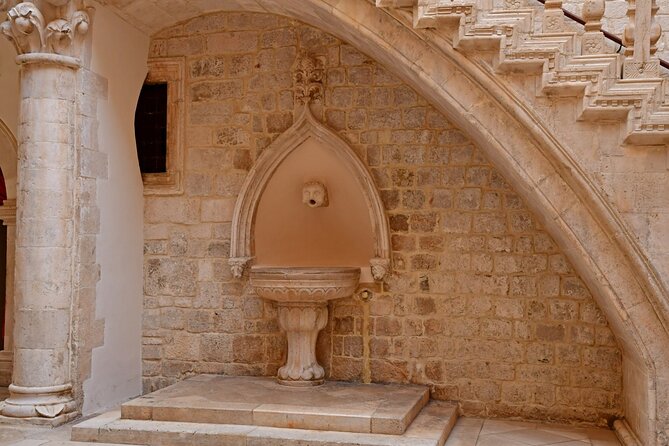
I would allow yourself time to look up, not only straight ahead. Architectural details can be easy to miss when the guide is explaining political events. If you enjoy buildings, listen to the history first, then take a moment to study the stonework and changes in style.
Seeing the museum’s most memorable objects
The permanent exhibition of the Cultural History Museum gives the palace personal and material detail. You are not limited to empty rooms or reconstructed atmosphere.
The collection includes the Rector’s ceremonial robes, portraits of Dubrovnik’s leaders, and ancient manuscripts recording the city’s development over the centuries. These objects connect the building to real people, official rituals, and the paperwork of government.
The sedan chairs are a particularly worthwhile detail. They were used by Dubrovnik’s patricians, and their presence helps you picture the practical side of status in the old republic. They are less expected than paintings or formal costumes, which makes them easy to remember after the tour.
The manuscripts offer another kind of evidence. A palace can feel remote when you only see polished stone and formal rooms. Written records bring you closer to the decisions and administration that kept the republic running.
The visit is not a large museum circuit. The indoor portion is listed as about 50 minutes, followed by roughly an hour of additional palace and nearby-area context. That pace suits you if you prefer explanation over rushing through a long display.
It may feel short if you want to read every label or inspect each object at length. One piece of feedback describes the visit as quite quick, and that is a fair consideration. The benefit is a focused introduction. The trade-off is that serious museum lovers may want extra time on their own.
More history tours in Croatia:
- Dubrovnik History, Sweets & Liquors in a Private Palace (PRIVATE)
★ 5.0 · 63 reviews - Split: Jewish Heritage & Diocletian’s Palace Walking Tour
★ 5.0 · 3 reviews - Dubrovnik History, Sweets & Liquors in a Private Palace
★ 5.0 · 3 reviews - Madrid Essential: Historic Center, Plaza Mayor & Royal Palace
★ 5.0 · 6,416 reviews
From political power to St. Blaise Church
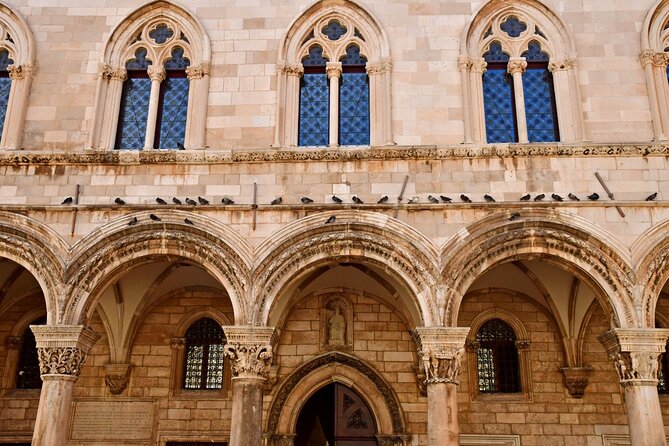
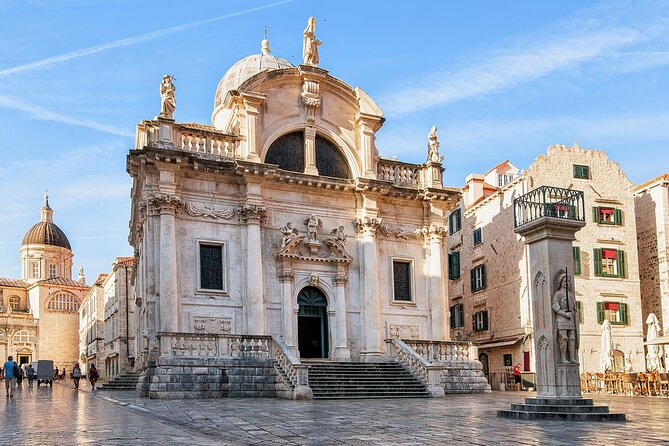
The tour does not end with the palace exhibits. Your guide also takes you toward nearby St. Blaise Church and the square around it.
St. Blaise is dedicated to Dubrovnik’s patron saint, so this part of the walk adds the city’s religious identity to the palace’s political story. The surrounding square also helps you understand how civic and religious buildings relate to one another in the Old Town.
This outdoor section is valuable because it stops the palace from feeling isolated. Dubrovnik’s history was not divided into neat boxes labeled government, religion, trade, and daily life. These parts occupied the same compact urban space.
You may also appreciate the change of pace. After rooms filled with objects and architectural details, the square gives you a chance to look at the surrounding buildings and ask broader questions. The guide can tailor the discussion toward art, architecture, or history, which is useful if your group has mixed interests.
The itinerary calls these nearby sights hidden gems, but I would keep expectations practical. The real value is not discovering an unknown monument. It is seeing familiar Old Town architecture with a clearer explanation of its religious and civic role.
What the private format adds
This is a private activity, so only your group participates. Groups can range from one to 20 people per guide, and larger parties receive additional guides at a higher price.
That setup matters most when your group has specific interests. You can ask about Dubrovnik’s rulers, the palace’s building styles, religious traditions, or the objects in the museum rather than simply following a fixed speech.
The guide is a five-star licensed professional fluent in your chosen language. English is the stated language for this departure. No individual guide’s name is provided in the tour information, so you should not expect to select a particular person when booking.
Private does not automatically mean slow or highly customized. The total duration remains about two hours, and the museum portion is fairly brisk. Still, a private guide usually makes it easier to stop for questions and hear the commentary clearly than a large general group.
For a couple, family, or small group celebrating a special trip, that personal attention may justify the cost. For a solo visitor or budget-minded pair, the same price is harder to defend, especially if museum entry is already covered by a Dubrovnik Pass.
Is $191.07 per person a fair price?
The listed price is $191.07 per person, and that requires an honest look at what you are buying. You are paying for a private two-hour experience, a licensed guide, and regular admission to the Rector’s Palace Cultural History Museum.
You are not paying for food, drinks, hotel pickup, or transportation. The start and end point are both in the Old Town area, so the main service is the guide’s time and interpretation.
If you simply want to enter the palace, the price is high. Admission is included in the Dubrovnik Pass, and one useful approach is to use the pass for the museum, then explore the palace independently. That option will not give you the same guided context, but it can be more cost-effective.
If your group includes several people, the private arrangement may look better when the total cost is shared. You also avoid being placed with strangers and can ask questions without competing for the guide’s attention.
I would book this tour for the guide-led explanation, not for admission alone. The building and museum are strong enough to visit independently, but the political background and architectural connections are easier to understand with someone interpreting the rooms.
Who will enjoy this palace tour most?
This experience suits you if you want Dubrovnik’s Old Town to make sense beyond its postcard views. History fans will appreciate the focus on the Republic of Ragusa, its leaders, diplomacy, and efforts to preserve independence.
It is also a good fit for architecture lovers. Gothic, Renaissance, and Baroque features appear within the same palace, giving you a compact lesson in how Dubrovnik’s built environment changed over time.
Art lovers should find enough to hold their attention through portraits, ceremonial clothing, manuscripts, and the museum setting. The tour is not presented as a specialist art course, though, so you should not book it expecting detailed analysis of every object.
Families may benefit from the private format because the guide can adapt the explanation to different ages. The manageable two-hour length also avoids turning the visit into an exhausting full-day museum program.
You may want to skip the guided version if you already know Dubrovnik’s political history, dislike scheduled commentary, or have the Dubrovnik Pass and want to keep costs low. In that case, visit the palace independently and spend the savings on another part of your Old Town day.
Timing, comfort, and practical details
The tour runs in all weather conditions. Dubrovnik’s summer sun can be strong, while rain can make polished stone uncomfortable underfoot, so bring suitable clothing and wear shoes with a good grip.
Most people can participate, and the meeting point is near public transportation. No food or drinks are included, so plan those separately before or after the activity.
The schedule gives you a short meeting period, about 50 minutes inside the palace museum, and another hour for palace context and nearby sights. The exact flow may vary with questions and the guide’s approach, but you should plan on a focused two-hour walk rather than a leisurely half-day visit.
The cancellation terms are simple: cancel at least 24 hours before the start time for a full refund. Cancellations or changes made within 24 hours are not refunded or accepted. The cut-off follows local Dubrovnik time.
How this compares with visiting alone
An independent visit gives you control. You can move at your own pace, use the Dubrovnik Pass if you have one, and pause as long as you like with the museum objects.
The private tour gives you context that labels cannot always provide. You hear how the palace fit into Dubrovnik’s government, why its architectural styles differ, and how the nearby church and square connect to the wider city.
I would choose the guided version if this is your first visit and you want a strong historical foundation. I would choose the self-guided option if you have limited interest in political history or prefer to linger over objects without a schedule.
The most important question is not simply how much the ticket costs. It is how much you value having the palace explained in real time. At this price, the guide must be the reason you book.
Should you book the Rector’s Palace tour?
Book it if you want a private, focused introduction to Dubrovnik’s government, architecture, and civic life, and if your group will make good use of the guide’s time. The palace is more substantial inside than it first appears, and the sedan chairs, manuscripts, robes, and portraits give the visit plenty of substance.
Think twice if you already own the Dubrovnik Pass or mainly want entry to the building. The admission is useful, but it does not by itself justify $191.07 per person.
My practical call: choose this for interpretation, not just access. For a small group with strong interest in history or architecture, it can be a rewarding two-hour anchor for a Dubrovnik visit. For a budget-conscious individual, the palace is still worth seeing, but an independent visit may be the wiser buy.
FAQ
Where does the Rector’s Palace tour begin?
The tour begins in front of NoneNina Bar at Ul. Pred Dvorom 4, 20000 Dubrovnik. Do not enter the bar, since its staff are not involved with the tour.
How long does the experience last?
The activity lasts approximately two hours. About 50 minutes are allocated to the Cultural History Museum, with additional time for the palace and nearby sights.
Is admission to Rector’s Palace included?
Yes. Regular admission to the permanent exhibition of the Rector’s Palace Cultural History Museum is included.
Is this a private tour?
Yes. Only your group participates. The group limit is 1 to 20 people per guide, and larger groups require additional guides at a higher price.
What language is the tour offered in?
The tour is offered in English. The included licensed guide is fluent in the language selected for the experience.
What is the cancellation policy?
You can cancel at least 24 hours before the start time for a full refund. Cancellations or changes made within 24 hours are not accepted, and the amount paid is not refunded.
Just added around Croatia
- Dubrovnik History, Sweets & Liquors in a Private Palace (PRIVATE)★ 5.0 · 63 reviews
- Split: Private Walking Tour and Diocletian’s Palace★ 5.0 · 3 reviews
- Split and Diocletian’s Palace walking tour with a local guid★ 4.9 · 36 reviews
- Split: Diocletian’s Palace Private walking tour★ 5.0 · 3 reviews
- Split: Jewish Heritage & Diocletian’s Palace Walking Tour★ 5.0 · 3 reviews
- Split: Private Walking Tour with Diocletian’s Palace★ 5.0 · 30 reviews
- Split: Old Town and Diocletian’s Palace Walking Tour★ 3.3 · 3 reviews
- Essential Diocletian’s Palace Tour for First-Time Visitors★ 4.9 · 79 reviews
Croatia Palace Tours, compared.
Walking Tour of Split and Diocletian’s Palace
Read our review →
Diocletian Palace & Old Town Guided Walking Tour
Read our review →

Game of Thrones Tour with Diocletian’s Palace Cellar
Read our review →
Diocletian’s Palace and Old Town SMALL GROUP Walking Tour
Read our review →
Browse the lists this tour appears in