
REVIEW · SPLIT PALACE TOURS
Split: 1.5-Hour Walking Tour and Diocletian’s Palace
Split’s old town is not a museum sealed behind glass. It is a living Roman palace, with homes, cafés, shops, laundry, and daily life tucked into ancient walls. This walking tour takes you from the South Gate and palace cellars to the Peristyle, the Riva waterfront, and the old city squares in about 90 minutes to two hours.
I like the way the route joins major sights with useful orientation. You see Roman, medieval, Venetian, and modern Split in one walk, and guides such as Ana, Sandra, Ivan, and Jelena have been praised for adding local stories, food tips, and practical advice. I also like the choice of English or Spanish. The main drawback is that entrance fees are extra, and the uneven old-town route is not suitable for people with limited mobility.
Key things to know before you book
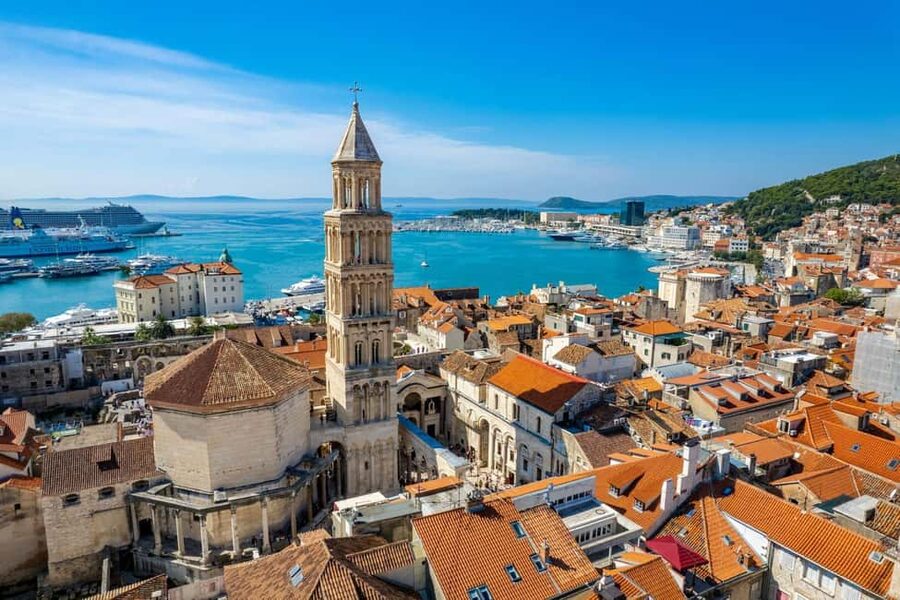
- Roman palace turned city center: Diocletian’s Palace is still part of everyday Split, not a distant archaeological site.
- A strong first-day orientation: The route links the Golden Gate, People’s Square, Fruit Square, Riva, Peristyle, and cathedral.
- Local guides add useful context: Ana, Sandra, Ivan, Jelena, and other guides have brought personal stories and tips on food and sightseeing.
- The Roman cellars are a highlight: You can see the lower palace level and understand how the imperial complex was built.
- Early or evening timing can help: An 8 a.m. start avoids some heat and crowds, while an 18:00 departure can feel cooler and calmer.
- Budget for optional entries: The guide is included, but entry charges, food, and drinks are not.
Why Diocletian’s Palace feels different from other ruins
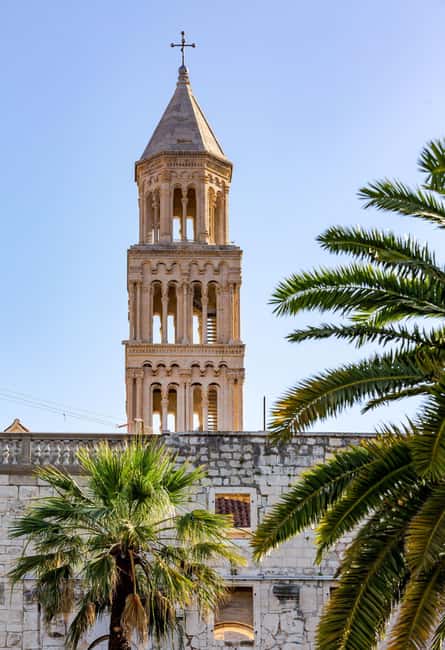
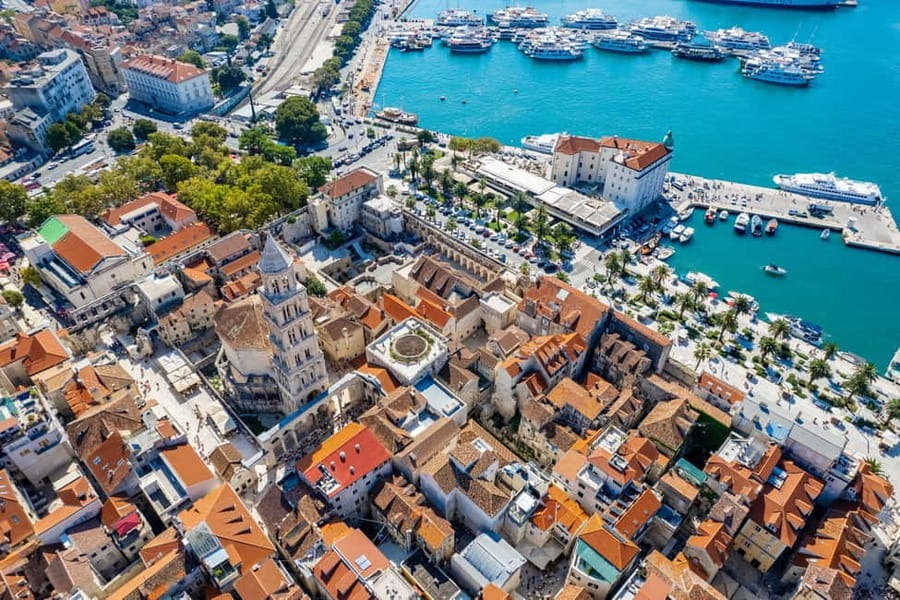
The first thing to understand is that Diocletian’s Palace is not simply a collection of old stones. It forms the core of Split’s old town. Streets pass through the former imperial complex, and the palace walls now frame ordinary city life.
The Roman Emperor Diocletian built the palace at the turn of the fourth century AD. The route helps you read its original plan, even after centuries of change. The South Gate, underground cellars, main square, and four major gates give the walk a clear structure.
I find this especially useful if you are new to Split. The lanes can seem confusing at first, but the guide shows how the Roman layout still controls the city center. After the walk, you should have a better sense of where to return for lunch, shopping, or a second look at the palace.
The tour also puts several periods side by side. You may see Roman stonework beside medieval walls, later Venetian details, and 20th-century buildings. That mixture is the real character of central Split. The city did not preserve the palace by leaving it untouched. It kept using it.
More walking tours past the palaces in Split:
- Split: Old Town and Diocletian Palace Walking Tour
★ 4.9 · 4,727 reviews - Walking Tour of Split and Diocletian’s Palace
★ 5.0 · 2,588 reviews - Split & Diocletian’s Palace Walking Tour
★ 5.0 · 1,125 reviews
Starting at the South Gate and going below the palace
The meeting point can vary depending on the option you book, with South Tours Travel Agency listed as a starting point. Check your booking details carefully before setting out, since the exact meeting location matters in a dense old town.
From the South Gate, the route moves toward the palace cellars. This is one of the most useful parts of the walk because the lower level shows the shape and scale of the imperial residence above. The cellars also help explain why parts of Split feel so solid and monumental.
You can expect a guided visit and walk through this section rather than a long archaeological lecture. The guide connects the underground rooms to the palace plan and explains how the Roman complex developed over time. Since entrance charges are not included, confirm what, if anything, you will pay for separately.
The cellars are also a good place to ask questions. Guides who have led this walk, including Sandra and Ana, are often described as patient and willing to explain details beyond the basic route. That matters here, since a short explanation can make an otherwise plain stone passage much easier to understand.
The Golden Gate and Split’s Roman front door
The Golden Gate is one of the central stops. It gives you a sense of how people entered the palace from the north and how impressive the approach must have felt in Roman times.
The stop is scheduled for about 10 minutes, so do not expect a long visit inside every structure. Instead, use this pause to look at the gate’s scale, its position in the old town, and the way later buildings have grown around it.
This is also a good point to get your bearings. The guide can help you understand the palace’s main directions and show how the old town continues beyond the Roman walls. If you plan to explore alone later, pay attention to the turns and shortcuts.
The nearby Game of Thrones Museum receives only a short sightseeing stop of about five minutes. The tour does not focus on television filming, but the guide may connect the modern attraction with Split’s old streets. One guide, Sandra, has been praised for adding filming locations even when they were not part of the original plan. Treat this as a brief extra, not the main reason to book.
People’s Square and the later city
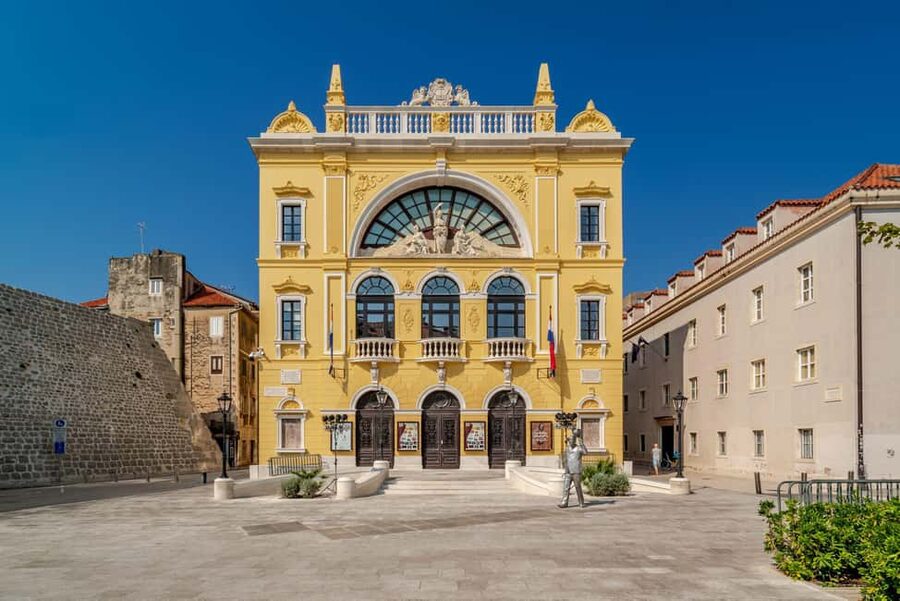
People’s Square shifts the focus from imperial Rome to the life of the later town. Here, the tour shows how Split expanded and changed after the palace ceased to function as an emperor’s residence.
The value of this stop is the contrast. You are not just looking at one ancient building. You are seeing how the city adapted Roman foundations for new civic and commercial uses. Guides also use this part of the route to explain Split as a living Croatian city, rather than only an ancient monument.
That local perspective is one of the tour’s strongest features. Ana has been praised for discussing culture, society, and current challenges in Croatia, while other guides have offered suggestions for local taverns and authentic food. The details will vary by guide, but the format leaves room for questions.
A few more palace visits around Split worth a look
- Split: Diocletian Palace & Old Town Guided Walking Tour
★ 4.7 · 882 reviews - Split Old Town and Diocletian’s Palace Tour
★ 4.8 · 716 reviews - Split: Game of Thrones Tour with Diocletian’s Palace Cellar
★ 4.8 · 545 reviews - Diocletian’s Palace and Old Town SMALL GROUP Walking Tour
★ 5.0 · 502 reviews
Fruit Square and old-town atmosphere
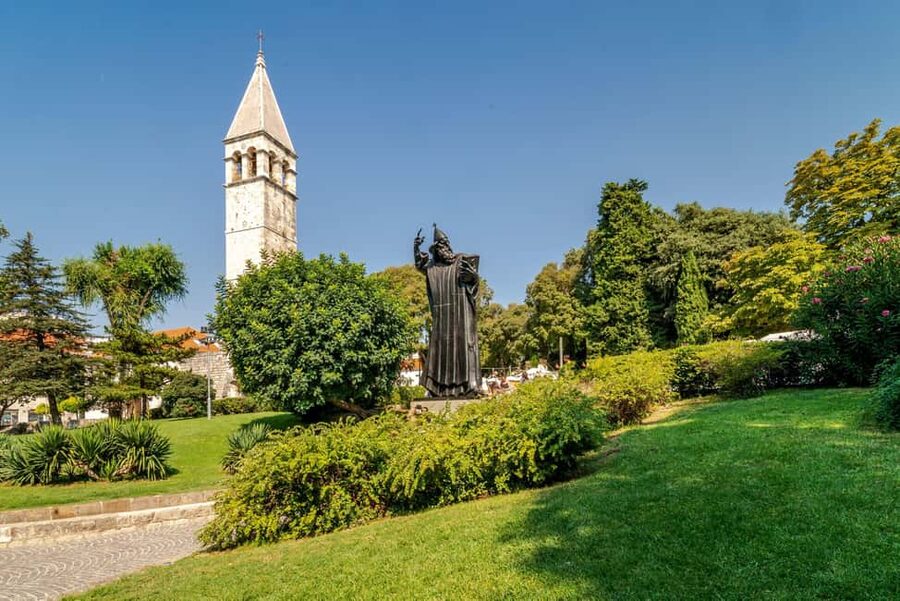
Voćni Trg, or Fruit Square, marks the site of the old fruit market. It is a useful stop because it connects architecture with ordinary trade and daily routines.
You can pause here and notice the mix of building styles around the square. The route does not treat Split as a single-period city. Roman remains, later stone buildings, and more recent additions sit close together.
I like this kind of stop more than a string of grand monuments. It shows how the old center works as a neighborhood. You may find the square more memorable after the guide explains what happened there than you would by simply photographing it.
The walk also gives you a chance to ask for practical recommendations. Guides have pointed people toward places to eat, viewpoints on Marjan Hill, and other things to do in Split. Write down suggestions as you go, since the tour moves through several areas quickly.
Riva waterfront and views toward Marjan Hill

The route continues to the Riva, Split’s waterfront promenade. This is the most open part of the walk and gives your eyes a break from the narrow palace lanes.
From the promenade, you get panoramic views toward Marjan Hill. The stop also places the palace in its coastal setting, which is easy to miss when you are focused on courtyards and stone passageways.
The guide may explain the port and its current role, not just the Roman past. That modern context helps you understand why Split has always depended on its position by the sea.
Timing matters here. A morning walk can be more comfortable before the heat builds, while an evening departure may offer softer light and fewer daytime crowds. One 8 a.m. experience was valued for getting ahead of heat and crowds, and an 18:00 start was described as a comfortable choice. Availability changes, so check the time when booking.
Peristyle, the palace’s grand central space
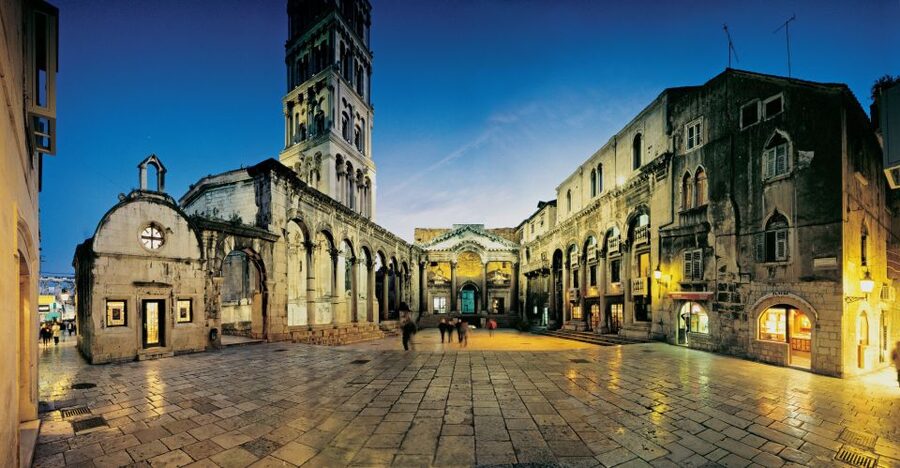
The Peristyle is the tour’s main visual moment. This was the central ceremonial square of Diocletian’s Palace, and it still feels like the place where the imperial idea becomes clear.
The guide points out the black granite Egyptian sphinx, described as the last remaining example in the area. Its presence is a sharp reminder of the empire’s reach and of the way Diocletian used architecture to project authority.
Allow yourself a moment to look up and around before listening to every detail. The surrounding columns and stone surfaces show how Roman design shaped the center of Split. Later life has grown around it, but the space still communicates its original purpose.
The scheduled visit lasts about 10 minutes. That is enough for a strong explanation and photographs, but it is not a long archaeological study. If you want to examine every carving or inscription, plan to return independently after the tour.
Saint Domnius Cathedral and the former mausoleum
The Cathedral of Saint Domnius is one of the most unusual stops because it began as Diocletian’s imperial mausoleum. The building was later adapted as a Christian cathedral, creating a direct link between Roman imperial power and the religious life of Split.
The tour presents it as the oldest Catholic cathedral in the world. The important point for you is that the cathedral is not a separate structure placed beside the palace. It is built from the heart of the original Roman complex.
The guide’s stop lasts about 10 minutes. Entrance fees are not included, so you should confirm the current arrangements if you want to enter beyond the guided sightseeing portion. The tour still gives you the key context even if you decide not to pay for an additional admission.
This is a spot where a clear guide makes a real difference. The change from mausoleum to cathedral can seem complicated, but a good explanation ties the building to the larger story of Split. Several guides have been praised for making the history lively with anecdotes rather than reciting dates alone.
Vestibule and the return through the palace
The Vestibule offers another look at the palace’s interior spaces. It is listed as a photo stop, visit, guided tour, and walk, with about 10 minutes scheduled here.
This part of the route helps connect the ceremonial spaces to the palace’s practical layout. You can look at the shape of the structure and see how visitors once moved toward the imperial apartments and central areas.
After the Vestibule, the walk returns toward the South Tours Travel Agency. The route is compact, but it covers a lot: gates, squares, waterfront, cellars, Peristyle, cathedral, and palace interiors.
The pace should suit most people who want a first look rather than an all-day history course. One guide described 90 minutes as the right length for keeping attention, while another tour lasted closer to two hours. Expect some variation depending on questions, group size, crowding, and the guide.
Guides and the local point of view
The guide can shape this experience more than any single monument. Guides named Ana, Sandra, Ivan, Jelena, Iva, and Elena have led versions of the walk, with English and Spanish offered.
The strongest guiding style here is personal but focused. Ana has been praised for showing Split through a Croatian perspective and for explaining both historic sights and present-day life. Sandra has been described as passionate about Split’s past and helpful with shortcuts. Ivan has been noted for a warm, relaxed manner and suggestions for other activities.
The group may not always be perfectly matched by language. One mixed English and Spanish tour was less smooth because the explanations had to serve both groups. If you are booking in a specific language, confirm the language option carefully.
Small groups can make the walk feel more flexible. Some departures have been nearly private, while other groups may be larger. Do not assume a private tour, but expect a guide who can answer questions when the group size allows.
Is $41 a fair price?
At $41 per person, this is not the cheapest way to look at Split’s old town. You can walk through much of the center on your own without paying an admission fee.
The value comes from structure and interpretation. In 90 minutes to two hours, you get a clear route through the palace, a local guide, historical context, and practical advice for the rest of your stay. If this is your first visit, that orientation can save time and prevent you from wandering past important details.
The price is easier to justify if you care about the Roman cellars, palace plan, cathedral, and the connection between ancient and modern Split. It is less attractive if you only want photographs or plan to explore slowly with a guidebook.
Remember that food, drinks, and entrance fees are not included. The guide fee covers the walking tour itself, so consider the $41 a payment for explanation and orientation rather than a bundled sightseeing pass.
Who should take this walk?
I would choose this tour for a first morning or first evening in Split. It gives you a map in your head, introduces the main sights, and leaves you time to return to the places that catch your interest.
It suits adults, couples, families with older children, and anyone who wants history explained in plain language. The local tips are also useful if you need help choosing a tavern, finding a viewpoint, or deciding which sights deserve another visit.
You should wear comfortable walking shoes. The route passes through old streets and palace spaces, and the tour is not recommended for people with limited mobility or mobility impairments.
If heat bothers you, look for an early or evening departure. If your schedule is tight, the compact length is a strength. If you want long interior visits, extensive cathedral time, or a slow archaeological study, you will need to add independent visits after the walk.
Should you book the Split walking tour?
Book it if you want a focused introduction to Split and prefer a local guide to connect the Roman palace with modern Croatian life. The cellars, Peristyle, cathedral, gates, old markets, and Riva make a well-balanced route, and the guides often add useful food and sightseeing advice.
Skip it if you are already well read on Diocletian’s Palace, want to set your own pace, or do not want to pay extra for admissions. For most first-time visitors, though, the $41 cost buys a useful start, especially when you choose a cooler early or evening time and return later to explore your favorite corners.
FAQ
How long does the walking tour last?
The tour lasts between 90 minutes and two hours. The exact length can vary with the guide, group, questions, and conditions along the route.
What sights are included?
The route includes the Golden Gate, Game of Thrones Museum area, People’s Square, Fruit Square, Riva, Diocletian’s Palace, Peristyle, Cathedral of Saint Domnius, Vestibule, and the palace cellars.
Is the cathedral included in the tour?
Cathedral of Saint Domnius is included as a guided sightseeing stop. Entrance fees are not included, so check the current admission details if you want to enter areas requiring a ticket.
Are the palace cellars included?
The route includes a visit to the Roman-era cellars beneath Diocletian’s Palace. Any entrance fee is separate from the tour price.
What languages are available?
The live tour guide is available in English or Spanish, depending on the option you select.
Where does the tour start?
The listed starting point is South Tours Travel Agency, but the meeting point may vary by the option booked. Check your booking information before arriving.
Is the tour suitable for people with limited mobility?
No. The tour is not recommended for people with limited mobility or mobility impairments. Comfortable walking shoes are recommended for the old-town route.
Just added around Split
- Split: Private Walking Tour and Diocletian’s Palace★ 5.0 · 3 reviews
- Split: Diocletian’s Palace Private walking tour★ 5.0 · 3 reviews
- Split: Jewish Heritage & Diocletian’s Palace Walking Tour★ 5.0 · 3 reviews
- Split and Diocletian’s Palace walking tour with a local guid★ 4.9 · 36 reviews
- Split: Private Walking Tour with Diocletian’s Palace★ 5.0 · 30 reviews
- Split: Old Town and Diocletian’s Palace Walking Tour★ 3.3 · 3 reviews
- Essential Diocletian’s Palace Tour for First-Time Visitors★ 4.9 · 79 reviews
- Split: Old Town & Diocletian’s Palace Earlybird Walking Tour★ 4.0 · 12 reviews
Split Palace Tours, compared.
Walking Tour of Split and Diocletian’s Palace
Read our review →

Diocletian Palace & Old Town Guided Walking Tour
Read our review →

Game of Thrones Tour with Diocletian’s Palace Cellar
Read our review →
Diocletian’s Palace and Old Town SMALL GROUP Walking Tour
Read our review →
Browse the lists this tour appears in