
REVIEW · ROYAL CASTLE TOURS
Kyoto: Nijo-jo Castle and Ninomaru Palace Guided Tour
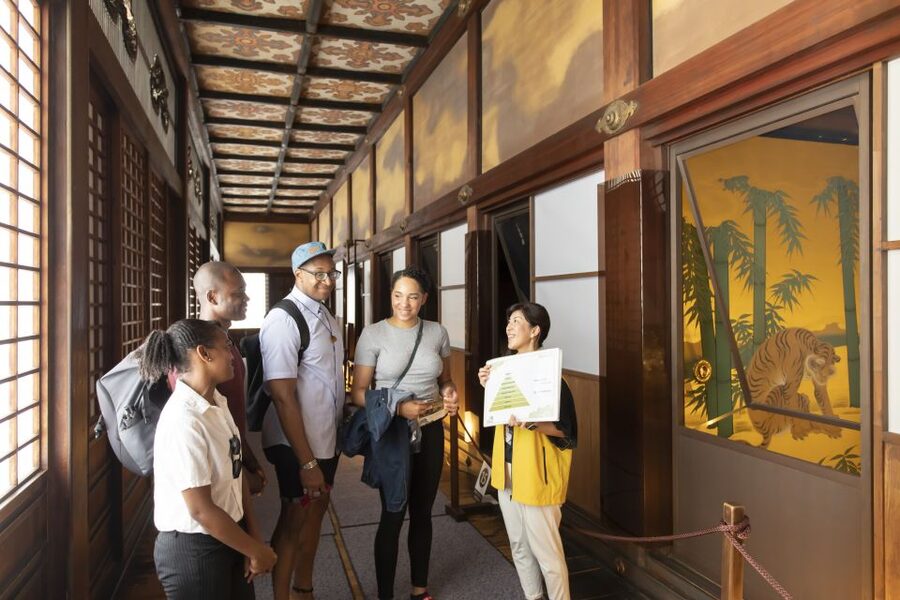
Nijo Castle’s greatest surprise is that its heart is not a stone fortress, but a beautifully decorated wooden palace where the shogun received visitors, handled politics, and watched for danger. The Ninomaru Palace makes that old power structure easy to picture, especially with a guide pointing out room functions, paintings, symbols, and security tricks.
I like the small-group feel reported on many departures and the chance to enter two areas not open to ordinary ticket holders. I also like that guides such as Miki, Kaoru, Ai, and Don explain the political story in clear English rather than simply naming buildings. The main drawback is practical: the tour lasts only one hour, admission to the castle costs extra in cash, and summer heat can be tough inside the palace.
Key points at a glance
- Hear the nightingale floors explained: The palace’s famous floors helped protect the shogun by making footsteps audible.
- See the shogun’s working world: Rooms were arranged for rank, ceremony, meetings, and private business.
- Enter restricted areas: Some departures include access to two rooms normally closed to the general public.
- Look closely at decoration: Painted tigers, dragons, birds, and plants carried political and symbolic meaning.
- Allow time after the tour: The guided hour covers the main sights, but the gardens and grounds deserve a slower walk.
- Bring water in hot weather: The palace has no air conditioning, and drinks are not allowed inside.
Why Nijo Castle feels different from a typical castle
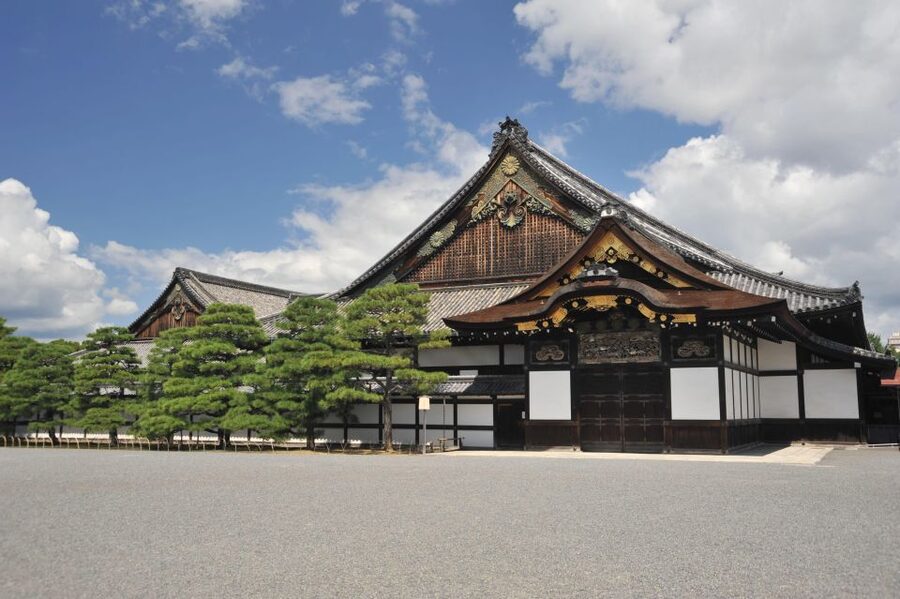
Nijo Castle was built in 1603 as the Kyoto residence of Tokugawa Ieyasu, the first shogun of the Edo Period. That date matters. The castle was not designed only for battle. It was also a political stage, a residence, and an office for the man who held Japan’s military power.
That is why I find the site more revealing than a simple fortress with walls and moats. You can see how authority was displayed through architecture. The closer a person came to the shogun, the more carefully the rooms, doors, decorations, and movement were controlled.
The Tokugawa Shogunate ended in 1867. After that, Nijo Castle became an imperial palace, and later Kyoto City received the property and opened it as a historic site. The buildings survived with an unusual amount of detail, making this one of Japan’s best places for seeing feudal-era architecture in its original setting.
Nijo Castle was named a UNESCO World Heritage site in 1994. The grounds are divided into the Honmaru, the main defensive circle, the Ninomaru, the secondary defensive circle, and gardens around both sections. This tour focuses on the East Main Gate, Karamon Gate, Ninomaru Palace, and Ninomaru Garden.
More Royal Castle Tours in Japan
- Tokyo Castle & Imperial PalaceーShogun Walking Tour
★ 4.7 · 1,068 reviews - Tokyo Castle & Imperial PalaceーShogun Walking Tour
★ 5.0 · 724 reviews - Imperial Palace East Garden and Edo Castle Walking Tour in Tokyo
★ 5.0 · 510 reviews
Starting at the East Main Gate
You enter through the East Main Gate and go to the reception area beside the General Reception. It is on the left after entering, next to the Nijo Castle tour ticket booth area. Your booking confirmation gives the precise meeting details, and the listed coordinates are 35.012586265298516, 135.75085333862305.
Arrive early. The guide cannot wait for people who are missing when the tour begins, and the one-hour schedule leaves little room for a late start. You also need to buy the castle admission separately, with cash required on site. The tour price is $16 per person, but the total cost is higher once you add the entrance fee.
Once the group gathers, the guide begins with the castle’s place in Japanese history. This opening is useful because the buildings can otherwise seem like a series of gates and decorated rooms. Guides including Ai, Miki, Kaoru, and Don have been especially effective at linking the architecture to the shogunate, the emperor, samurai customs, and court politics.
Karamon Gate and the language of power
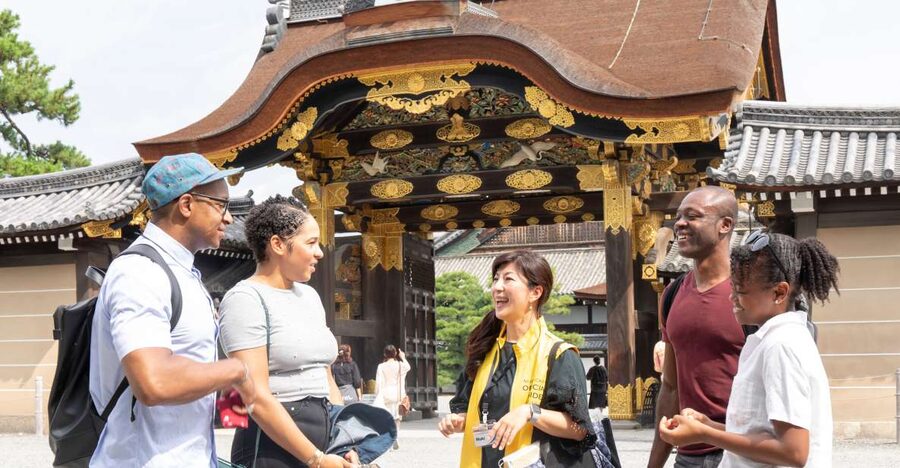
The route leads toward Karamon Gate, the ornate entrance to the Ninomaru area. This is one of the first moments when Nijo Castle’s style becomes clear. The gate is decorative and ceremonial, not merely defensive.
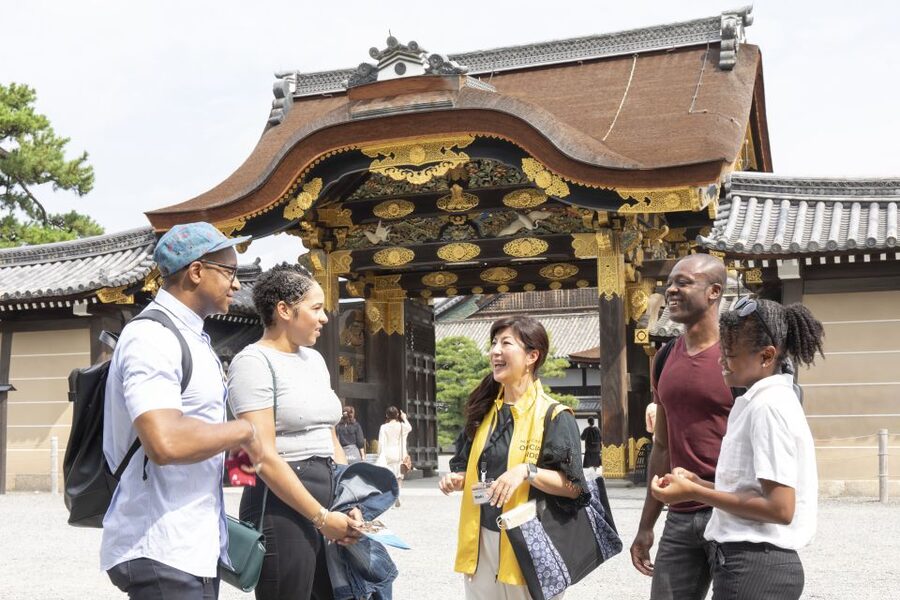
Take time to study the carved and painted details. Guides point out symbolism in the animals, plants, and patterns, helping you understand that decoration here was not random. The gate announced status before you ever reached the palace.
This is also where a guide adds real value over a self-guided walk. On your own, you can admire the bright colors and elaborate workmanship. With an English explanation, you begin to see the gate as part of a political message. The shogun’s residence needed to look powerful, controlled, and worthy of formal visitors.
The tour moves at a measured pace rather than rushing past each feature. That matters when the castle is busy. One guide, Michiko, was praised for keeping a group together through crowded palace rooms while explaining the architecture in short, clear sections. That is the kind of practical guiding you need here.
Ninomaru Palace, the main event
Ninomaru Palace is the center of the experience. It once served as the shogun’s residence and office during visits to Kyoto, and it remains intact. You remove your shoes before entering and follow the prescribed route through the wooden corridors and rooms.
Photography is not allowed inside the palace. There is also no air conditioning, and water cannot be carried inside, so prepare before you cross the threshold. In August, the interior can feel very warm, especially during a heat wave. Wear light clothing and drink water beforehand.
The famous nightingale floors are one of the palace’s best-known features. Their joints were designed to make a soft chirping sound underfoot. The purpose was practical: footsteps could be heard, making it harder for an intruder to move quietly toward the shogun.
The floor is memorable, but do not focus only on the sound. The palace layout tells you how the shogun managed contact with other people. Rooms were assigned according to rank and purpose. A guide can explain where formal meetings took place, how officials approached the shogun, and how private quarters differed from public rooms.
This is where the tour’s historical context earns its $16 price. Without help, you may see paintings and empty rooms but miss the social rules built into the layout. With a guide, the palace becomes a working political machine.
Same city, a very different set of state rooms:
- Tokyo: Imperial Palace and Shogun Historical Walking Tour
★ 5.0 · 2,251 reviews - Tokyo: Imperial Palace Japanese History Walking Tour
★ 4.9 · 987 reviews - Tokyo: Imperial Palace and Shogun Walking Tour
★ 4.9 · 935 reviews - Kyoto: Imperial Palace & Nijo Castle Guided Walking Tour
★ 4.7 · 453 reviews
Paintings, tigers, dragons, and daily life
The interior decorations deserve close attention. Painted screens and wall panels show animals, plants, and other subjects that carried meaning in the world of the shogun.
Guides have pointed out details such as fierce tigers, dragons, and other creatures. Some visitors have even connected certain carved figures with imagery familiar from popular Japanese culture, including possible inspiration for Dragon Ball characters and Pokémon designs. Those connections should be treated as entertaining observations, not the main historical lesson, but they make the artwork easier to remember.
The paintings also helped communicate rank and purpose. A room used for a more formal audience needed a different visual tone from one used for private business. Guide explanations can cover the reasons behind particular artworks, the position of officials, the preparation of meals, and the fear of poisoning at a powerful person’s table.
That last detail helps you picture the palace as a place of constant caution. A meal was not simply a meal, and a room was not simply a room. Ceremony, hospitality, and security worked together.
The best guides keep this information digestible. Ai, Ayu, Miki, Kaoru, and Don have all been singled out for clear English, humor, patience, and an ability to answer questions. Names and staff can change, of course, but the experience depends heavily on who leads your departure.
The extra access that can make the tour worthwhile
The activity includes exclusive access to part of the castle normally unavailable to the general public. Several departures have included two additional rooms connected with the shogun’s private quarters.
This is the strongest reason to book a guided visit instead of simply buying admission and walking alone. You are not paying only for a spoken history lesson. You may also see spaces that ordinary admission does not include.
Access can depend on the day and the guide’s permitted route, so I would not treat every restricted room as guaranteed. Still, the possibility adds real value, especially if you have already seen Japanese castles or palace interiors elsewhere.
Ask your guide questions when you reach these areas. This is a good time to ask about privacy, rank, daily routines, and how the shogun’s private spaces differed from the formal audience rooms. The one-hour format gives you enough time for questions, but not enough for a long discussion after every stop.
Ninomaru Garden and the part after the guide
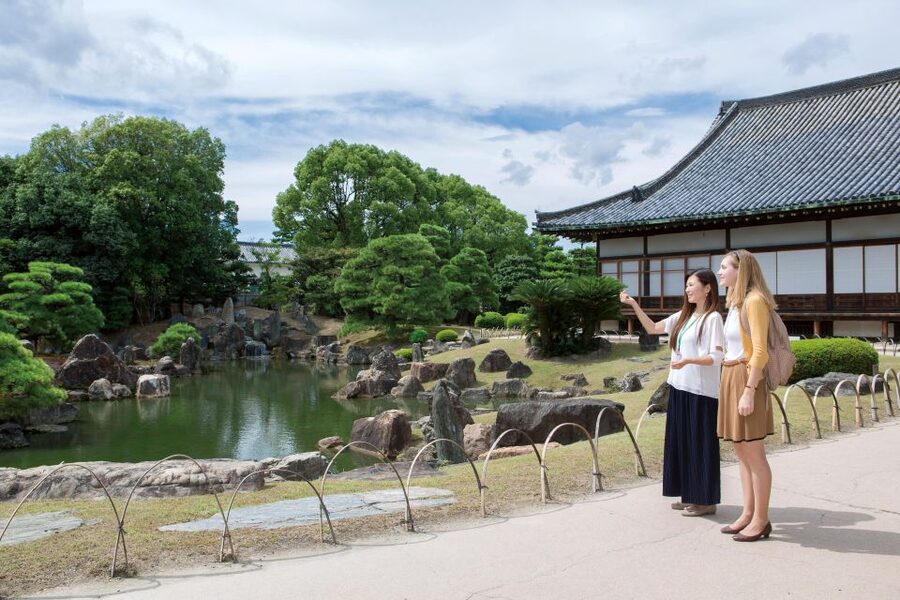
The tour includes Ninomaru Garden, which gives you a welcome change after the indoor palace. The garden surrounds the palace area with a calmer setting and helps you understand how buildings and open spaces worked together.
The guided portion lasts 60 minutes. That is enough to cover the main architecture and historical points, but it is not enough for a slow exploration of the entire castle grounds. I recommend treating the tour as the anchor of a longer visit.
After the guide leaves, walk at your own pace through the gardens and the wider castle grounds. One advantage of the short tour is that you are free to continue alone rather than being tied to a longer group schedule.
A small rest area with refreshments and gifts has also been noted after the tour. Do not count on the tour itself to provide drinks inside the palace, though. Bring a cold drink for before or after the indoor portion, especially from June through August.
Price, timing, and the real value
At $16 per person, the guide fee is modest for Kyoto, particularly if your group receives access to restricted rooms. The separate castle admission is the catch. You pay that fee in cash on site, so keep Japanese yen ready and consider the total cost before booking.
Each paid adult may bring one child aged 0 to 12 free of charge. The child must stay with an adult. Earphones are provided only to paid participants, so a child who needs an earphone requires an adult ticket. If you bring more than one child, each additional child needs an adult ticket.
The tour is conducted only in English. That makes it a good fit for English-speaking visitors who want clear historical explanation, but not for anyone seeking a multilingual departure.
Free cancellation is available up to 24 hours before the start time. Ninomaru Palace is closed on Tuesdays in July, August, December, and January, as well as from December 26 through January 3. Check the available departure times before you build the rest of your Kyoto day around it.
Who should book this one-hour tour?
I recommend it most strongly if you enjoy understanding why a place was built, not just photographing it. The tour suits first-time visitors to Kyoto, families with older children, and anyone interested in samurai customs, political history, architecture, or Japanese art.
It is also a smart choice for solo visitors. Guides have helped individual participants take photographs outside the palace and join the group without feeling lost. Small groups are common, though group size can vary.
You might skip the guide if you want to spend all day wandering independently or if you dislike fixed schedules. You will still see the castle with ordinary admission, and the grounds are rewarding on their own. But you will miss much of the meaning behind the palace rooms, artwork, security features, and social order.
The heat is the main comfort issue. In summer, guides have worked hard to keep groups moving safely, but the palace has no air conditioning. Plan your clothing, water breaks, and timing with that in mind.
Should you book Nijo Castle with a guide?
Yes, if you can manage the extra admission fee and an English-only tour. The castle is worth seeing without a guide, but the palace makes far more sense when someone explains the rank system, room functions, symbolism, and shogun-era security.
Book it for the access to restricted spaces, the focused one-hour route, and the chance to hear strong guides such as Miki, Kaoru, Ai, Ayu, and Don explain the site with warmth and humor. Skip it only if you prefer complete independence or want a long, unhurried visit without a set start time.
Arrive early at the East Main Gate, bring cash for admission, drink water before entering the palace, and leave time afterward for the garden. Done that way, this is a compact and worthwhile way to understand Kyoto’s political past.
FAQ
How long does the Nijo Castle guided tour last?
The guided tour lasts 60 minutes.
What language is the tour conducted in?
The tour is conducted only in English with a live English-speaking guide.
Is Nijo Castle admission included in the $16 tour price?
No. The castle admission fee is separate and must be paid in cash on site.
Where do I meet the guide?
Enter through the East Main Gate and go to the reception area next to the General Reception, on the left after entering. The meeting point is listed as the Nijo Castle Tour Ticket Booth area in the booking confirmation.
Can children join the tour for free?
Each paid participant may bring one child aged 0 to 12 free of charge. The child must be accompanied by an adult.
Are earphones provided for children?
Earphones are provided only to paid participants. If a child needs an earphone, you must purchase an adult ticket for that child.
When is Ninomaru Palace closed?
Ninomaru Palace is closed every Tuesday in July, August, December, and January, and from December 26 through January 3.
Just added around Japan
- Tokyo walking tour around Imperial Palace and Tokyo Station★ 5.0 · 3 reviews
- Tokyo: Imperial Palace, the history of Japan (ENGLISH GUIDE)★ 5.0 · 77 reviews
- Tokyo: Pvt. Tour – Edo Castle & Imperial Palace East Gardens★ 4.8 · 63 reviews
- Tokyo: Imperial Palace East Gardens and Tokyo Station Tour★ 5.0 · 16 reviews
- Tokyo: Imperial Palace with Nostalgic Alley Kagurazaka tour★ 4.3 · 8 reviews
- Tokyo: Edo Castle and Imperial Palace Guided Walking Tour★ 5.0 · 6 reviews
- Tokyo: Edo Castle Ruins & Imperial Palace East Garden Tour★ 4.4 · 13 reviews
- Kyoto: Nijo Castle and Kyoto Imperial Palace Guided Tour★ 4.6 · 98 reviews
Royal Castle Tours, compared.

Stonehenge, Windsor Castle, and Bath from London
Read our review →
Dracula’s Castle, Peles Castle, & Brasov Old Town
Read our review →
Neuschwanstein & Linderhof Castle Full-Day Trip
Read our review →
Dracula Castle, Peles Castle & Brasov Old Town
Read our review →
Prague Castle 2.5-Hour Tour Including Admission Ticket
Read our review →
Stonehenge, Windsor Castle and Bath with Pub Lunch in Lacock
Read our review →
Neuschwanstein & Linderhof Castle-Fairytale Day Tour from Munich
Read our review →
Browse the lists this tour appears in