
REVIEW · ROYAL CASTLE TOURS
Tokyo Castle & Imperial PalaceーShogun Walking Tour
Edo Castle was once so enormous that today’s Imperial Palace grounds reveal only pieces of its former scale. This two-hour walk connects moats, stone walls, gates, gardens, and castle ruins with the story of samurai rule, the shogun, and Japan’s long imperial tradition.
I like the small group of up to 10, which makes it easier to ask questions and keep a sensible pace. I also like that guides such as Anju, Fuma, Yuka, Tomo, and Keiko bring the site to life with clear explanations, fun facts, and help with photos. The main consideration is that much of the tour is outdoors, and $23 is more than the cost of simply entering public garden areas, so you are paying mainly for interpretation rather than admission.
Key points to know before you book
- The castle is mostly gone, but its defenses remain: Moats, gates, stonework, and watchtowers show why Edo Castle was so difficult to attack.
- The tour connects past and present: You learn how the shogun’s capital became modern Tokyo and how the Imperial Palace functions today.
- The gardens are more than pretty scenery: Ninomaru Garden, seasonal trees, koi, and old palace grounds come with explanations that are easy to miss alone.
- English is the only tour language: Japanese support is not available, so book only if you are comfortable following an English walking tour.
- The pace is calm and conversational: Several reviews highlight patient guides, friendly explanations, and time for questions rather than a rushed march.
- Plan for weather and security: The route is largely outside, and you pass through a security check where knives and alcohol are not allowed.
Why Edo Castle makes a smart first history walk in Tokyo
Tokyo can feel modern from the moment you step out of the station. Glass towers, broad avenues, and busy commercial districts do little to reveal that this city grew around the seat of the Tokugawa shoguns. The Imperial Palace grounds provide a rare chance to see that older Tokyo with your own eyes.
This tour focuses on Edo Castle, the stronghold that helped support roughly 260 years of samurai rule. The castle itself no longer survives as a complete building, but its footprint remains visible in the moats, gates, stone foundations, and elevated defensive points.
That is why a guide matters here. Without context, an old wall can look like an old wall. With an explanation of layered defenses, controlled entrances, and the castle’s enormous size, the same stones begin to make sense.
The tour also places the shogun’s government beside Japan’s imperial tradition. You hear about the emperor’s long line, described on the tour as a 2,600-year system, and consider how that tradition continued through major political changes. It is a useful way to connect ancient customs, the Edo period, and present-day Japan in one walk.
More Royal Castle Tours in Japan
- Tokyo Castle & Imperial PalaceーShogun Walking Tour
★ 5.0 · 724 reviews - Imperial Palace East Garden and Edo Castle Walking Tour in Tokyo
★ 5.0 · 510 reviews - Tokyo Castle, Imperial Palace, Shogun & Garden Walking Tour
★ 5.0 · 211 reviews
Meeting at Wadakura Fountain Park
The starting point is in front of Starbucks Coffee Kōkyo Gaien Wadakura Fountain Park Store, at 3-1 Kōkyo Gaien, Chiyoda City. Look for a guide holding a sign marked Local Guide Stars.
This is a practical meeting place because you have a clear landmark and a nearby park setting before the walk begins. Still, do not treat the Starbucks sign as the entire experience. Arrive ready to walk outside, since the route quickly leaves the comfort of the café area and heads into open palace grounds.
The group is capped at 10 people. That limit matters on a history walk. You can usually hear the guide more easily than in a large bus group, and questions do not have to compete with dozens of other voices.
The guide roster changes. Anju has been praised for her clear storytelling and patient answers. Fuma is noted for fun facts, warm energy, and helpful recommendations for the rest of a Tokyo visit. Yuka has been described as easy to understand and willing to take photos. Tomo, Keiko, Koyo, Ai, Kazuki, Mai, Nana, and others have also led tours.
That variety means the exact personality of your tour depends on the day. The consistent theme is a friendly, conversational approach, with guides often using questions, small quizzes, and personal comparisons to make the past easier to follow.
Sakurada Tatsumi Yagura and the first look at the defenses

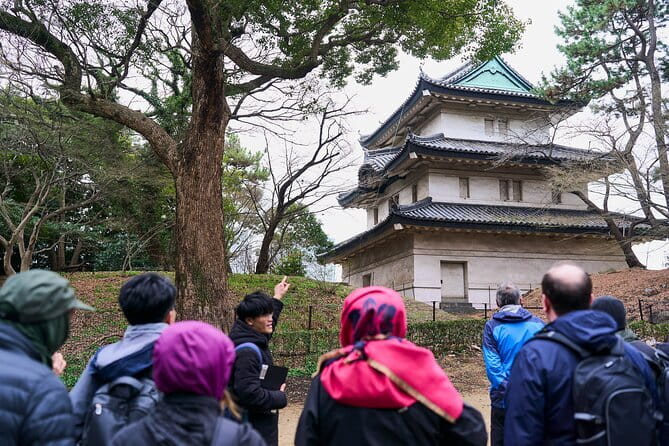
The first stop is Sakurada Tatsumi Yagura, a five-minute visit and photo stop. This watchtower gives you an early clue about the practical side of Edo Castle.
A yagura was not simply decoration. It helped monitor movement and protect an important part of the castle system. The guide uses this stop to explain how the castle’s defenses worked together rather than relying on a single wall or gate.
The stop is brief, so do not expect a long examination of the structure. Its value comes from setting up the rest of the walk. Once you understand that Edo Castle was planned as a huge defensive complex, the later moats and entrances have a clearer purpose.
This is also a good point to take photographs before the group moves farther into the grounds. The tour encourages photography, and the open palace area provides plenty of chances for pictures of stonework, water, trees, and formal views.
Ote-Mon Gate shows how power was controlled
The walk continues to Ote-Mon Gate, with about 15 minutes for viewing and explanation. This was a major entrance to Edo Castle, and it is one of the best places to picture the castle as a working center of government rather than a quiet park.
Look closely at the approach. Gates and walls were designed to slow movement, control access, and make an attack difficult. A skilled guide points out details you might otherwise pass without a second thought, including the way defenses were layered.
That practical focus is one of the tour’s strengths. The story is not only about famous samurai names or palace ceremonies. You also learn how people moved through the castle, why entry points mattered, and how the layout supported the shogun’s authority.
The stop is still a sightseeing visit, not a military engineering lecture. You will get a clear overview rather than a specialist study. For most visitors, that balance works well, especially early in a Tokyo trip when you want useful background without spending half a day on one narrow topic.
More royal castle tours in Tokyo:
- Tokyo: Edo Castle & East Garden of the Imperial Palace Tour
★ 4.7 · 112 reviews - Tokyo: Pvt. Tour – Edo Castle & Imperial Palace East Gardens
★ 4.8 · 63 reviews - Tokyo: Edo Castle Ruins & Imperial Palace East Garden Tour
★ 4.4 · 13 reviews - Tokyo: Edo Castle and Imperial Palace Guided Walking Tour
★ 5.0 · 6 reviews
The Imperial Palace connects Edo rule with Japan today
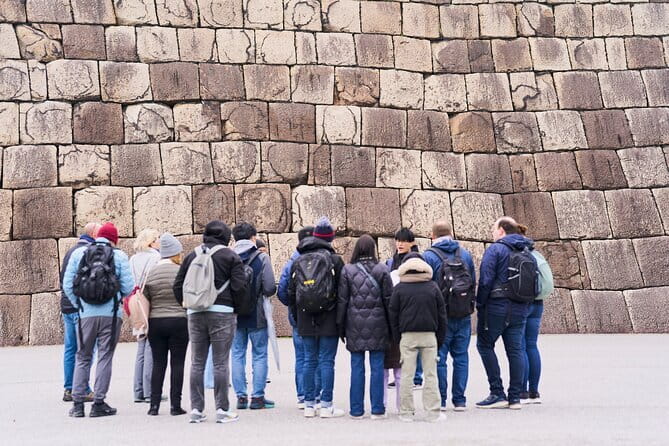
The Imperial Palace stop lasts about 20 minutes. Here the tour shifts from the shogun’s castle to the present-day imperial residence.
The palace is not simply a preserved samurai site. It is also part of Japan’s living political and cultural tradition. That contrast gives the walk its main point: you are not looking at an isolated ruin, but at a place where different eras overlap.
Your guide explains how Edo Castle became the Imperial Palace and discusses the endurance of Japan’s imperial system. This helps you avoid a common misunderstanding. The shogun and the emperor were not interchangeable figures. The walk gives you a framework for understanding their different roles and how political power changed over time.
You should expect outdoor views and historical interpretation rather than a full tour of palace interiors. The activity takes place on the grounds, and access to specific palace buildings is not described as part of the route.
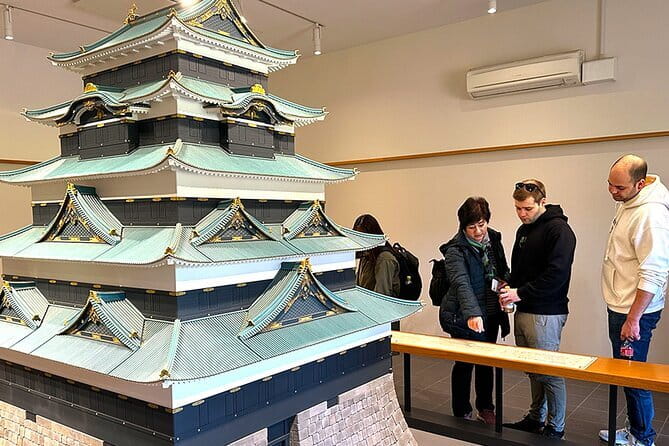
The scale can be hard to grasp from ground level. That is why the included miniature structure of the former palace is useful. A model can show the arrangement and size of buildings more clearly than a surviving wall or foundation.
Ninomaru Garden slows the tour down
After the palace area, the group spends about 15 minutes in Ninomaru Garden. This is where the walk becomes less about defenses and more about daily life, design, and the controlled beauty expected around a ruler’s residence.
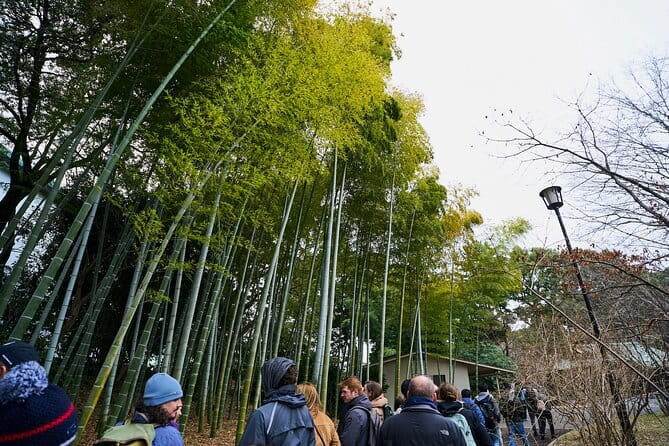
The garden includes seasonal plantings, carefully arranged views, and trees from different parts of Japan. You may also see special koi. The guide explains what you are looking at instead of leaving you to admire it without context.
I like this part because it gives the tour a change of rhythm. Edo Castle was a place of surveillance and ceremony, but it was also a place of gardens, shade, water, and cultivated beauty. The garden helps you picture the human side of life around the castle.
The exact appearance depends on the season. Spring, summer, autumn, and winter each bring different colors and textures, but the tour does not promise a particular display. Bring a camera, though. The garden, koi ponds, old trees, and stone features create some of the easiest photo opportunities of the walk.
Edo Castle ruins reveal the missing palace
The Edo Castle Ruins stop lasts about 10 minutes. Here, the absence of the original castle becomes part of the story.
You will see remnants rather than a complete keep or grand palace complex. That can disappoint anyone expecting a restored Japanese castle with interior rooms and dramatic wooden towers. Tokyo’s central castle site is more about traces, foundations, and scale.
The guide fills in the gaps by explaining what once stood there and how large the castle complex was. Several guides also use the ruins to describe the movement from Edo period authority to the modern city around it.
This is a good place to keep your expectations realistic. If you want a complete castle building, places such as Himeji offer a different experience. If you want to understand how a vanished castle shaped Tokyo, the ruins are more rewarding than they first appear.
The East Gardens bring the history together
The final major stop is the Imperial Palace East Gardens, with around 20 minutes for a guided visit. This is the longest garden portion of the route and a fitting place to bring the different stories together.
Here you can encounter more trees from across Japan, seasonal scenery, old stonework, and the remains of the former castle. The gardens offer room to pause and take in the contrast between quiet greenery and the city beyond the palace grounds.
A good guide connects the scenery to the political story. You might learn why a particular part of the grounds mattered, how the castle was defended, or how the site changed after the samurai era. The point is not to race from one famous object to another. It is to help you read the grounds as a historical place.
The tour returns to the Starbucks meeting point. The planned duration is two hours, though one guide, Kosei, was known to run slightly over because he kept answering questions and sharing cultural comparisons. Do not count on extra time, but the walking pace is generally described as relaxed rather than hurried.
What $23 buys you
At $23 per person, this is an inexpensive guided experience by Tokyo standards, but the value depends on what you want.
You are not paying for a major admission ticket or access to private palace rooms. You are paying for two hours of explanation, a small group, an English-speaking guide, and a route that combines several parts of the palace grounds.
If you already know Edo-period history and are comfortable reading maps and signs on your own, you may prefer to explore independently. The gardens may not require a costly ticket, and you can take your time without staying with a group.
For most first-time visitors, I think the price is reasonable. The grounds are large, the castle is mostly missing, and the historical details are easy to overlook. A guide provides the structure that turns a pleasant walk into a readable story.
The strongest value comes when your guide is active and responsive. Anju, Fuma, K, Kosei, Mai, and others have been praised for clear English, good pacing, humor, and patience with questions. The small group also makes the price feel less like a generic sightseeing package and more like a personal orientation to central Tokyo.
Practical details for comfort and access
Wear shoes suitable for walking and dress for the day’s weather. Much of the route is outdoors, and the palace grounds can feel exposed in sun, wind, rain, or cold.
There is a security check when entering the Imperial Palace area. Do not bring knives or alcohol. Photography is encouraged, so a phone or camera is worthwhile.
Wheelchairs are available and can be used within the Imperial Palace grounds. Some slopes and sections still require walking or going down on foot, so anyone with mobility concerns should consider the route carefully before booking.
The tour is in English only. Japanese language support is not available. The guides are often young and energetic, and some have studied or lived abroad, which can help when they compare Japanese customs with international ones.
Free cancellation is available up to 24 hours before the activity for a full refund. You can also reserve now and pay later, which is useful if your Tokyo schedule is still shifting.
Who should book this Imperial Palace walk?
I would choose this tour if you want a clear introduction to the Edo period, samurai society, the shogun, and the Imperial Palace without committing to a full-day museum visit.
It suits history fans, first-time visitors, culture-focused families, and anyone who has become curious about Japan’s past through television or books. One participant who had watched Shōgun found the added historical perspectives especially useful, but you do not need prior knowledge to follow the tour.
It is less suitable if you want access to palace interiors, a complete surviving castle, or a long, slow garden photography session. The route covers several stops in two hours, so you will get a broad picture rather than a detailed study of every wall and tree.
Should you book the Tokyo Castle and Imperial Palace Shogun Walking Tour?
Book it if you want the Imperial Palace grounds to make sense. The moats, gates, gardens, miniature palace structure, and ruins are far more interesting when you understand how they fit into the story of Edo Castle and the shogun’s government.
At $23, the tour offers good value for an English-speaking visitor who wants context, a manageable route, and a small group. Go prepared for outdoor walking, modest castle remains, and a guide-led overview rather than access to palace interiors.
If those limits match your expectations, this is a smart way to spend two hours in central Tokyo. You get history, gardens, photographs, and a better sense of how modern Tokyo grew around the seat of samurai power.
FAQ
Where does the tour start and finish?
The tour starts and finishes in front of Starbucks Coffee Kōkyo Gaien Wadakura Fountain Park Store at 3-1 Kōkyo Gaien, Chiyoda City, Tokyo.
How long does the tour last?
The planned duration is two hours. The route returns to the starting point after visiting the palace grounds, gardens, gates, and Edo Castle remains.
Is the tour conducted in English?
Yes. The live tour guide speaks English only, and Japanese language support is not available.
How large is the group?
The group is limited to 10 participants.
What places are visited?
The route includes Sakurada Tatsumi Yagura, Ote-Mon Gate, Tokyo Imperial Palace, Ninomaru Garden, Edo Castle Ruins, and the Imperial Palace East Gardens.
Can I take photographs?
Yes. Photography is encouraged throughout the tour, so bring a camera or use your phone to capture the gardens, koi, stone walls, gates, and seasonal scenery.
What should I avoid bringing?
Do not bring knives or alcohol. You will pass through a security check when entering the Imperial Palace area.
More Walking Tours Past the Palaces in Tokyo
- Tokyo: Imperial Palace and Shogun Historical Walking Tour
★ 5.0 · 2,251 reviews - Tokyo: Imperial Palace Japanese History Walking Tour
★ 4.9 · 987 reviews - Tokyo: Imperial Palace and Shogun Walking Tour
★ 4.9 · 935 reviews - Tokyo: Imperial Palace East Gardens Walking Tour
★ 4.8 · 353 reviews
Just added around Tokyo
- Tokyo walking tour around Imperial Palace and Tokyo Station★ 5.0 · 3 reviews
- Tokyo: Imperial Palace, the history of Japan (ENGLISH GUIDE)★ 5.0 · 77 reviews
- Tokyo: Pvt. Tour – Edo Castle & Imperial Palace East Gardens★ 4.8 · 63 reviews
- Tokyo: Imperial Palace East Gardens and Tokyo Station Tour★ 5.0 · 16 reviews
- Tokyo: Imperial Palace with Nostalgic Alley Kagurazaka tour★ 4.3 · 8 reviews
- Tokyo: Edo Castle and Imperial Palace Guided Walking Tour★ 5.0 · 6 reviews
- Tokyo: Edo Castle Ruins & Imperial Palace East Garden Tour★ 4.4 · 13 reviews
- Imperial Palace Tour: Discover Samurai History with a Guide★ 5.0 · 12 reviews
Royal Castle Tours, compared.
Stonehenge, Windsor Castle, and Bath from London
Read our review →
Dracula’s Castle, Peles Castle, & Brasov Old Town
Read our review →
Neuschwanstein & Linderhof Castle Full-Day Trip
Read our review →
Dracula Castle, Peles Castle & Brasov Old Town
Read our review →
Prague Castle 2.5-Hour Tour Including Admission Ticket
Read our review →
Stonehenge, Windsor Castle and Bath with Pub Lunch in Lacock
Read our review →
Neuschwanstein & Linderhof Castle-Fairytale Day Tour from Munich
Read our review →
Browse the lists this tour appears in