
REVIEW · ROYAL CASTLE TOURS
Tokyo Castle & Imperial PalaceーShogun Walking Tour
Tokyo’s Imperial Palace grounds reveal their best secret in the stonework. Behind the handsome gardens and broad avenues sits the former Edo Castle, a fortress built to protect the shogun with gates, guardhouses, walls, and carefully planned turns. This two-hour walk explains how that system worked, then softens the military story with koi ponds and a traditional garden.
I like the small-group format of up to 10, at least as the tour is designed, because a good guide can answer questions and point out details you would miss alone. I also like the price: at $23.88, you are paying for interpretation rather than admission, since the stops are free. The main consideration is that the walk is outdoors, with stairs, slopes, and plenty of sun exposure.
The tour is best for first-time visitors who want a clear introduction to samurai power, Edo Castle, and Japan’s imperial system. English is the only tour language, the Emperor’s residence is closed to the public, and the stated maximum for the activity can reach 60 people, so confirm the group size for your date if that matters.
Key details that shape the experience
- Edo Castle’s defenses: Study massive gates, stone walls, watchtowers, and guardhouses built to protect the shogun.
- A two-hour history lesson: Move at a steady pace through nine points, with time for photos and questions.
- Guides who use visual aids: Guides such as Keiko have used laminated images of old castle layouts, towers, and the royal family to make lost buildings easier to imagine.
- A peaceful garden finish: Ninomaru Garden brings koi, seasonal plants, and quiet paths after the military story.
- Free-entry sights: No separate admission is listed for the stops, so the $23.88 mainly pays for the guide.
- Outdoor walking: Bring water and sun protection, and expect stairs and steep slopes.
Why Edo Castle is the real star
The Imperial Palace is not just a royal compound. It occupies the center of what was once Edo Castle, the seat of the Tokugawa shoguns and one of Japan’s most powerful political centers. The original castle was far larger and more heavily defended than the surviving walls alone suggest.
That is why this tour works best with a guide. If you simply stroll through the East Gardens, you will see attractive stonework and old foundations, but the military logic can be easy to miss. The guide connects each gate, tower, and guardhouse to the people who used it.
The tour also gives you a useful way to sort out Japan’s overlapping stories. You hear about samurai, shoguns, emperors, the Edo period, and the modern Imperial Palace without treating them as one undifferentiated past. Guides including K, Tomo, Keiko, Ai, Shin, and Yuki have been praised for making that background clear, lively, and easy to follow in English.
Do not expect an indoor palace tour. The Emperor’s residence is not open to the public, and this experience focuses on the outer grounds, the former castle structures, and the gardens.
More Royal Castle Tours in Japan
- Tokyo Castle & Imperial PalaceーShogun Walking Tour
★ 4.7 · 1,068 reviews - Imperial Palace East Garden and Edo Castle Walking Tour in Tokyo
★ 5.0 · 510 reviews - Tokyo Castle, Imperial Palace, Shogun & Garden Walking Tour
★ 5.0 · 211 reviews
Starting at Wadakura Fountain Park
The meeting point is the Starbucks Coffee in Kokyo Gaien Wadakura Fountain Park, at 3-1 Kōkyogaien in Chiyoda City. The location is near public transportation, but allow enough time to find the correct Starbucks and gather before the walk begins.
This is a sensible starting area. The broad open space gives the guide room to assemble the group before leading you toward the palace grounds. It also puts you near the ginkgo-lined avenues and formal open spaces around Tokyo Station.
Bring your booking confirmation on your phone. The activity uses a mobile ticket, and confirmation is provided when you book. Since entry includes a security check, leave knives and alcohol behind. Those are specifically prohibited for entry.
The tour is conducted in English only. If you need Japanese-language support, this is not the right choice.
Sakurada Tatsumi Yagura, a surviving Edo-period tower
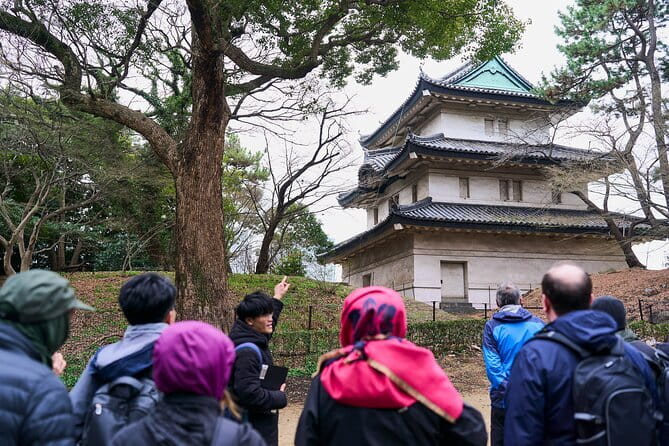
The first major stop is Sakurada Tatsumi Yagura, a surviving turret from the Edo period. You get about 20 minutes here, making it the longest scheduled stop on the walk.
A turret like this helps you picture the castle as a working defense system, not just a scenic park. The guide explains the security arrangements that still shape access around the Imperial Palace today. Look closely at the position of the tower and its relationship to the walls. Its value is not only architectural. It shows how defenders watched movement and controlled approaches.
This is also a good early photo stop, but keep your attention on the explanation. The point is less about entering a grand building and more about understanding how the castle’s outer protections worked.
Otemon Gate and the logic of the walls

At Kokyo Otemon Gate, you see two heavy gates and large stone walls connected with the original castle. The scheduled stop is about 10 minutes.
Here the guide explains why a castle entrance could be more complicated than a simple opening in a wall. The layout forced people to pass through controlled spaces, giving guards time and position to respond. That basic idea makes later stops easier to understand.
The gates also offer some of the clearest physical evidence of Edo Castle’s scale. Much of the castle’s main architecture is gone, but the stone foundations, gate structures, and surviving towers still show the seriousness of its defenses.
More royal castle tours in Tokyo:
- Tokyo: Edo Castle & East Garden of the Imperial Palace Tour
★ 4.7 · 112 reviews - Tokyo: Pvt. Tour – Edo Castle & Imperial Palace East Gardens
★ 4.8 · 63 reviews - Tokyo: Edo Castle Ruins & Imperial Palace East Garden Tour
★ 4.4 · 13 reviews - Tokyo: Edo Castle and Imperial Palace Guided Walking Tour
★ 5.0 · 6 reviews
Three guardhouses and the samurai hierarchy
The Constable Guardhouse, Hyakunin Bansho Guardhouse, and Obansho Guardhouse form the heart of the samurai portion of the walk. Each receives about 10 minutes, but each represents a different layer of castle security.
The Constable Guardhouse was used by lower-ranking samurai. This gives the guide a chance to explain that samurai society was not one uniform class of warriors. Rank, duties, and access mattered.
Hyakunin Bansho was a larger guardhouse where many samurai were stationed. Its size helps you think about the number of people required to protect a castle of this importance. It was not guarded by a handful of dramatic sword fighters. It relied on organized staff, watch points, rules, and layers of control.
At Obansho, near the inner gate, the focus shifts to higher-ranking samurai and their duties. The sequence is useful because you see the castle’s security from the outside toward the center. You also get a clearer picture of how status shaped work inside the shogun’s compound.
This is where the guide can add the most value. A plaque may identify a building, but a good explanation tells you who stood there, what they were watching, and why the location mattered.
Fujimi-yagura and the lost view of Edo
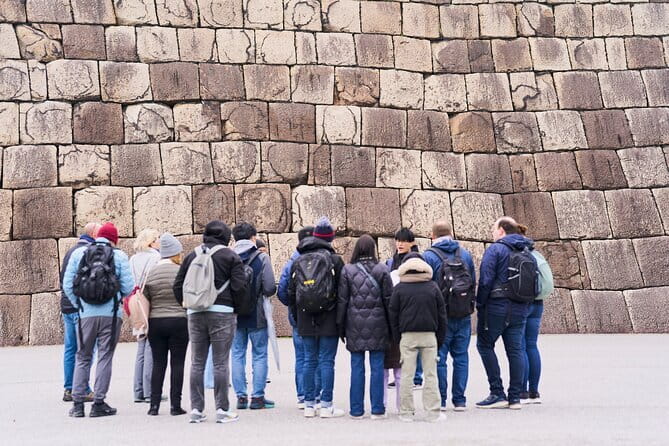
Fujimi-yagura is an old watchtower overlooking the grounds. The stop lasts about 10 minutes and focuses on its former role and special features.
The name points to the idea of seeing Mount Fuji, although the important point for this tour is the tower’s place in the castle’s watch system. It was both useful and symbolic, a high structure that helped monitor the surrounding area and signaled the power of the castle.
You will not be climbing a tower as part of the stated itinerary. The interest comes from seeing the surviving structure and hearing how it fitted into the wider defenses.
A model of the castle at Kokyo Sannomaru Shozokan
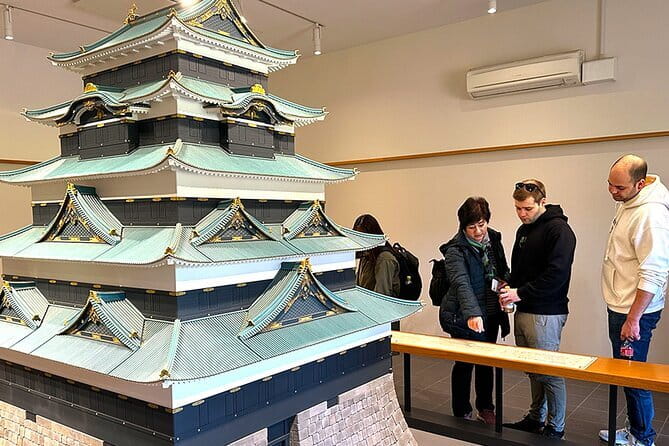
The Kokyo Sannomaru Shozokan stop gives you a scale model of the former Edo Castle and a souvenir shop with palace-related goods. The visit is scheduled for about 10 minutes.
This is one of the most helpful moments for anyone who struggles to imagine the original castle. Today’s grounds contain open spaces, gardens, foundations, and scattered historic structures. A model restores the missing scale and shows how the pieces once related to one another.
Guides may also use printed images during the walk. Keiko, for example, has been noted for carrying laminated pictures of older castle layouts, guard towers, and members of the royal family. These simple visual aids can make a major difference, especially when you are looking at a foundation and trying to picture a tall wooden building that no longer exists.
The souvenir shop is a minor stop, but it gives you a chance to browse palace-related items without turning the tour into a shopping outing.
The Edo Castle main tower site
The East Gardens of the Imperial Palace contain the former site of Edo Castle’s main tower. The scheduled visit lasts about 15 minutes.
The tower is gone, and that absence is part of the story. The guide explains why the main tower no longer stands and what remains on the site. You are looking at foundations and open ground rather than a restored interior, so set your expectations accordingly.
This stop is especially useful if you care about the difference between reconstruction and survival. The Imperial Palace grounds do not present a complete, preserved castle. Instead, you see fragments that survived fire, change, and modernization. The guide helps you read those fragments.
The East Gardens are also one of the more open parts of the walk. On a hot day, that means sun. Several people have found the tour more comfortable with water, a hat, and an umbrella for shade. Most of the route is exposed, so do not count on continuous cover.
Ninomaru Garden, a quieter side of the palace grounds
After the gates, walls, and guardhouses, Ninomaru Garden changes the mood. You spend about 15 minutes among seasonal plants and a pond with koi.
I like this contrast. The garden is not an unrelated add-on. It shows another side of the former castle grounds, where careful design and peaceful scenery replaced the pressure of guard duty and political control. The pond and plants provide a slower final chapter to the tour.
This is one of the better spots for photographs, but it is also a chance to pause and absorb the setting. You have spent the earlier part of the walk learning how the shogun’s compound kept people out. Here, you see the cultivated beauty that helped make the grounds more than a military machine.
The garden can also be the most comfortable part of the route emotionally, though it does not remove the practical need for water and suitable shoes.
A short tour with a useful historical arc
The route is carefully paced for about two hours. You are not spending long stretches inside one building, since the accessible sights are mostly outdoor structures and grounds. Instead, the tour builds a story through short stops.
The order makes sense:
- First, you see the outer turret and major gates.
- Next, you learn how samurai staffing and rank supported security.
- Then, you view a watchtower and a model of the vanished castle.
- Finally, you see the main tower site and relax in Ninomaru Garden.
The tour concludes in front of the ginkgo-lined avenue stretching toward Tokyo Station, although the meeting information also says the activity ends back at the meeting point. Because those descriptions differ, check the exact end point with the guide on the day. Either way, the route keeps you in a central part of Tokyo.
The walking is manageable for most people according to the activity information, but it is not a flat, indoor stroll. You may need to handle steep slopes and stairs. Comfortable footwear matters more than fashionable footwear here.
What the $23.88 price really buys
At $23.88 per person, this is a low-cost guided experience in central Tokyo. Since the listed stops have free admission, the price pays for the English-speaking guide, organization, and historical explanation.
That is good value if you want context. The palace grounds are attractive on their own, but the castle’s defense system, samurai ranks, and changing political role are not always obvious from the path. A guide turns a collection of walls and gardens into a connected story.
The value depends on your interests. If you prefer exploring at your own pace and reading signs, you can walk through free public areas without paying for a tour. If you want someone to answer questions, compare old and modern layouts, and explain why each guardhouse mattered, the modest fee is easier to justify.
The tour has a 4.9 rating from 725 ratings, with 99 percent recommending it. The strongest pattern is the guide’s ability to make history clear and entertaining. K is repeatedly singled out for strong English, humor, and detailed answers. Other guide names associated with positive experiences include Ai, Anju, Nana, Yuko, Yuki, Shin, Dai, Mayuko, Mako, and Franky.
There is one caution. At least one person found the guide’s English difficult to follow and left early. The activity is English only, so communication quality matters. The high overall rating suggests this is usually a strength, but it is still wise to choose a tour only if you are comfortable learning through spoken English.
Who should book this walk
I would choose this tour early in a Tokyo stay if you want a historical framework for the city. It gives you useful background before visiting other sites connected with samurai culture, the shogunate, or the imperial family.
It suits:
- First-time Tokyo visitors who want an introduction to Edo and the Imperial Palace.
- Families who prefer a short, guided walk to a long museum visit.
- History fans interested in samurai ranks, castle defenses, and the shogun.
- Photographers who want gates, stone walls, towers, gardens, and koi.
- People who like asking questions in a small group.
It is less suitable if you want to enter the Emperor’s residence, tour furnished palace rooms, or see a fully reconstructed Edo Castle. It is also a poor match for anyone avoiding stairs, steep slopes, prolonged outdoor exposure, or English-language tours.
Book at least 24 hours before the start time if you want the protection of free cancellation. Cancellations made less than 24 hours before the start are not refunded, and late changes are not accepted.
Should you book the Tokyo Castle and Imperial Palace walk?
Book it if you want the Imperial Palace grounds to make sense rather than simply look pretty. For $23.88, two hours with an engaging guide can supply the missing connections between stone walls, samurai guardhouses, the vanished castle tower, and the modern imperial system.
Go in expecting an outdoor history walk, not palace access. Bring water, sun protection, comfortable shoes, and only the English-language expectations the tour can meet. If those limits suit you, this is a practical and inexpensive way to understand why Edo Castle still matters in the middle of modern Tokyo.
FAQ
How long is the Tokyo Castle and Imperial Palace Shogun Walking Tour?
The tour lasts approximately two hours.
What is the price of the tour?
The listed price is $23.88 per person.
Is the tour conducted in English?
Yes. The tour is conducted in English only, and Japanese-language support is not available.
Where does the tour start?
The meeting point is Starbucks Coffee in Kokyo Gaien Wadakura Fountain Park, 3-1 Kōkyogaien, Chiyoda City, Tokyo 100-0002, Japan.
What sights are included?
The route includes Sakurada Tatsumi Yagura, Kokyo Otemon Gate, the Constable Guardhouse, Hyakunin Bansho Guardhouse, Obansho Guardhouse, Fujimi-yagura, Kokyo Sannomaru Shozokan, the Edo Castle main tower site in the East Gardens, and Ninomaru Garden.
Is admission included at the stops?
The listed stops have free admission.
Can I enter the Emperor’s residence?
No. The Emperor’s residence is not open to the public as part of this experience.
Are there security restrictions?
Yes. You must pass a security check to enter the Imperial Palace grounds. Do not bring knives or alcohol.
Is the tour suitable for most people?
Most people can participate, but the route includes steep slopes and stairs. Comfortable shoes are recommended.
More Walking Tours Past the Palaces in Tokyo
- Tokyo: Imperial Palace and Shogun Historical Walking Tour
★ 5.0 · 2,251 reviews - Tokyo: Imperial Palace Japanese History Walking Tour
★ 4.9 · 987 reviews - Tokyo: Imperial Palace and Shogun Walking Tour
★ 4.9 · 935 reviews - Tokyo: Imperial Palace East Gardens Walking Tour
★ 4.8 · 353 reviews
Just added around Tokyo
- Tokyo walking tour around Imperial Palace and Tokyo Station★ 5.0 · 3 reviews
- Tokyo: Imperial Palace, the history of Japan (ENGLISH GUIDE)★ 5.0 · 77 reviews
- Tokyo: Pvt. Tour – Edo Castle & Imperial Palace East Gardens★ 4.8 · 63 reviews
- Tokyo: Imperial Palace East Gardens and Tokyo Station Tour★ 5.0 · 16 reviews
- Tokyo: Imperial Palace with Nostalgic Alley Kagurazaka tour★ 4.3 · 8 reviews
- Tokyo: Edo Castle and Imperial Palace Guided Walking Tour★ 5.0 · 6 reviews
- Tokyo: Edo Castle Ruins & Imperial Palace East Garden Tour★ 4.4 · 13 reviews
- Imperial Palace Tour: Discover Samurai History with a Guide★ 5.0 · 12 reviews
Royal Castle Tours, compared.
Stonehenge, Windsor Castle, and Bath from London
Read our review →
Dracula’s Castle, Peles Castle, & Brasov Old Town
Read our review →
Neuschwanstein & Linderhof Castle Full-Day Trip
Read our review →
Dracula Castle, Peles Castle & Brasov Old Town
Read our review →
Prague Castle 2.5-Hour Tour Including Admission Ticket
Read our review →
Stonehenge, Windsor Castle and Bath with Pub Lunch in Lacock
Read our review →
Neuschwanstein & Linderhof Castle-Fairytale Day Tour from Munich
Read our review →
Browse the lists this tour appears in